
Meta description: Are generic medicines really as good as brand-name drugs? A pharmacist explains how generics are approved, why they cost less, where the real concerns lie, and how to choose with confidence.
Tags: #Pharmacy #Healthcare #GenericDrugs #PatientEducation #MedicationSafety
Reading time: about 12 minutes
We’ve all been there. You’re at the pharmacy counter picking up a new prescription, and the pharmacist asks: “Would you like the brand name or the generic?”
For many people, that question brings a moment of doubt. Is the generic really as good? Why is it so much cheaper? Is my doctor okay with this? Am I trading my health for a lower price?
I work in pharmacy, and I hear these questions every day. They’re good questions. You should understand what you’re putting in your body. This guide walks through everything I wish every patient knew: what generics are, how they’re approved, why they look and cost different, the honest debate about quality, the situations where brand or consistency matters, and practical steps for your next pharmacy visit.
What is a generic medicine?
The short answer: an FDA-approved generic medicine works the same way as its brand-name counterpart, and for most people it’s a safe, effective choice.
A generic is a copy of a brand-name drug, made after the original’s patent protection ends. It must contain the same active ingredient, in the same strength and dosage form (tablet, capsule, liquid, patch), and be taken by the same route (by mouth, injection, inhaler, and so on). If the brand-name drug lowers your blood pressure, the generic does the same job.
Generics aren’t new. The modern U.S. system dates to 1984, when Congress passed the Drug Price Competition and Patent Term Restoration Act, better known as the Hatch-Waxman Act. It created a faster approval path for generics while giving brand-name companies some patent protection back for time lost during development. That compromise is the reason your pharmacy shelves are full of affordable options today.
The numbers show how central generics have become. According to the FDA, about 9 out of every 10 prescriptions filled in the United States are for generic drugs.
How the FDA approves a generic
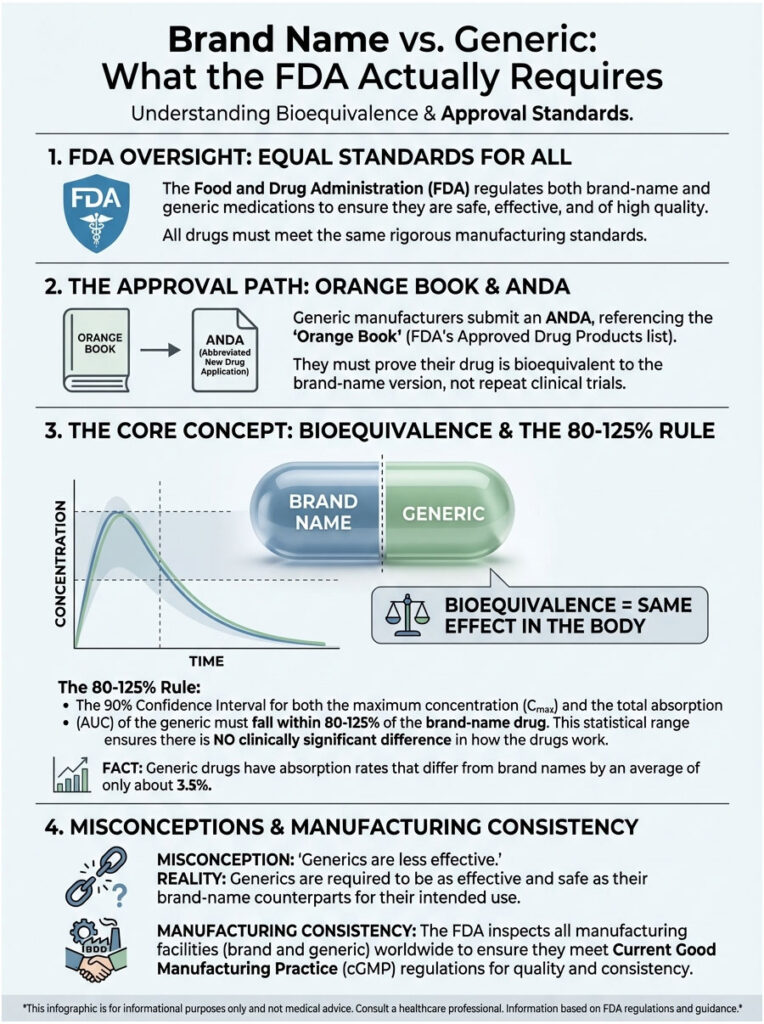
A generic company doesn’t have to repeat the large clinical trials the original drug went through. The brand already proved that the active ingredient is safe and effective. The generic’s job is to prove that its version delivers that ingredient to your body the same way.
To do that, the manufacturer files an Abbreviated New Drug Application (ANDA) with the FDA. The application must show:
- The same active ingredient, strength, dosage form, and route as the brand
- The same approved uses and directions
- That it is made in a facility meeting the FDA’s manufacturing standards (called Current Good Manufacturing Practice)
- That it is bioequivalent to the brand
Bioequivalence, in plain language
Bioequivalence means the generic gets into your bloodstream at essentially the same rate and to the same extent as the brand. To test it, healthy volunteers take the brand and the generic at different times. Researchers then measure how much drug reaches the blood and how quickly.
You may have heard a rumor that generics can contain “20% less” medicine. That isn’t true. The FDA’s statistical test is strict, and in practice the differences are small. A review of 12 years of FDA bioequivalence studies found that generics and brands differed in absorption by only about 3 to 4% on average, which is similar to the variation between different batches of the same brand.
The Orange Book: how pharmacists know a generic can be swapped
The FDA publishes a reference called the Orange Book (officially, Approved Drug Products with Therapeutic Equivalence Evaluations). It gives each generic a code. Products rated “A” (most commonly “AB”) are considered therapeutically equivalent to the brand, so your pharmacist can substitute them with confidence.
If they’re the same, why do they look different?
Your generic pill may be a different color, shape, or size from the brand-name one you’ve seen on TV. That isn’t a sign of lower quality. It’s required by trademark law, which stops generic makers from copying the brand’s exact look.
Every tablet or capsule has two kinds of ingredients:
| Ingredient type | What it does | Must it match the brand? |
|---|---|---|
| Active ingredient | Treats your condition | Yes, exactly |
| Inactive ingredients (fillers, binders, dyes, flavors, coatings, preservatives) | Gives the pill its shape, color, taste, and shelf life | No, these can differ |
The inactive ingredients are approved as safe, but they can matter to some people. They’re also why two generics of the same drug, from two different companies, can look different from each other. If your refill suddenly looks new, it may simply come from a different manufacturer.
Pro tip: If you’re allergic or sensitive to a dye, gluten, lactose, or another filler, tell your pharmacist. We can look up each manufacturer’s inactive ingredients and find one that’s safe for you.
Safety tip: If your pill looks different and nobody mentioned a change, always ask before taking it. It’s almost always just a new manufacturer, but checking also catches the rare dispensing error.
Why is the generic so much cheaper?
The price gap has nothing to do with quality and everything to do with economics.
1. The brand paid for discovery. Bringing a new medicine to market takes many years of laboratory research and clinical trials, and can cost billions of dollars. Many promising drugs fail along the way, and the successful ones have to pay for those failures too.
2. Patents protect that investment. A patent typically lasts 20 years from the date it’s filed. Much of that time passes while the drug is still in development, so the brand’s exclusive selling window is often shorter. The FDA can also grant separate periods of marketing exclusivity. During this time, the brand sets the price.
3. Generics skip the expensive part. Once patents and exclusivity end, generic companies can enter. They prove bioequivalence instead of repeating large trials, so their costs are much lower.
4. Competition drives prices down. When one generic arrives, prices drop. When several companies make the same drug, they compete on price, and costs often fall dramatically.
The savings add up. An industry report produced with the IQVIA Institute estimated that generic and biosimilar medicines saved the U.S. healthcare system $496 billion in 2025 alone.
Quality and manufacturing: an honest look
Brand-name and generic manufacturers are held to the same FDA manufacturing standards, and the FDA inspects factories in the U.S. and overseas. Many brand-name companies also make generics, sometimes in the same plants. Most generics on your pharmacy shelf are made well and work as expected.
It would be wrong, though, to pretend there’s no debate. Much of the world’s generic supply is made in India and China, and over the years there have been recalls for contamination, impurities, and poor record-keeping at some plants. In March 2026, two physicians writing in the New England Journal of Medicine argued that quality varies between manufacturers more than the public is told. They noted that foreign plants can go years between FDA inspections, and that finished generic products aren’t routinely tested by the agency. They called for independent testing and public quality ratings. The FDA, for its part, continues to state that approved generics meet the same quality standards as brand-name drugs.
What this means for you:
- The debate is about manufacturing consistency at some plants, not about whether the generic idea works. The science of bioequivalence is sound.
- Recalls are announced publicly. Your pharmacy is notified and will contact you if a product you take is affected.
- If a medicine seems to work differently after a change, report it (see “What to do if you notice a change” below). Patient reports help regulators spot problem products.
- Don’t stop a medicine on your own because of a news story. Talk to your pharmacist first.
Common myths, busted
Myth: “Cheaper means weaker.” The lower price reflects skipped research costs and competition, not a weaker product. The active ingredient and strength are the same.
Myth: “Generics take longer to work.” Bioequivalence testing specifically checks how fast the drug reaches your blood, not just how much. An approved generic has to match the brand on both.
Myth: “Generics have more side effects.” The active ingredient causes most side effects, and that’s identical. In rare cases, a person may react to an inactive ingredient, such as a dye. Your pharmacist can help you find a better match.
Myth: “Generics are made in dirty factories.” Generic and brand facilities must meet the same FDA standards, and many brand companies make generics themselves. Quality problems at specific plants do happen, as covered above, but they’re not the norm.
Myth: “My doctor prescribed the brand, so I have to take the brand.” In most U.S. states, pharmacists may substitute an equivalent generic unless your prescriber specifically says not to. If you or your doctor have a reason to stay on the brand, just say so.
When consistency or brand matters
For most medicines, switching between brand and generic, or between generic makers, is routine. A few situations deserve more care.
Narrow therapeutic index (NTI) drugs
With these medicines, the gap between an effective dose and a harmful one is small, so even minor differences can matter. Common examples include:
- Thyroid medications, such as levothyroxine
- Blood thinners, such as warfarin
- Certain anti-seizure medications, such as phenytoin
- Some transplant medications, such as tacrolimus
- Lithium, used for bipolar disorder
Generics of these drugs are approved and widely used. The point is consistency: your doctor or pharmacist may ask you to stay with one manufacturer, brand or generic, and may check your blood levels after any switch.
Special delivery forms
Extended-release tablets, inhalers, skin patches, and injectable pens depend on how the product releases or delivers the drug, not just what’s in it. A different device can also mean a different technique. If your inhaler or pen changes, ask your pharmacist to show you how to use the new one.
Authorized generics
Sometimes the brand company itself sells its product under a generic label. These authorized generics are the brand drug in plain packaging, often at a lower price. Ask your pharmacist if one exists for your medicine.
Biosimilars
Biologic medicines (like some treatments for arthritis, diabetes, and cancer) are made from living cells and are too complex to copy exactly. Their lower-cost versions are called biosimilars. They’re tested to show no meaningful clinical difference from the original, and some are approved as “interchangeable,” meaning a pharmacist may substitute them, depending on state law.
Insurance, substitution rules, and saving money
Insurance usually favors generics. Many plans put generics in their lowest copay tier, and some cover only the generic. If you choose the brand when a generic exists, you may pay the price difference yourself.
Substitution is the default in most states. Pharmacists can usually swap in an A-rated generic automatically. If your prescriber writes “Dispense as Written” or “Brand Medically Necessary,” the pharmacist will fill the brand. Rules differ from state to state, especially for NTI drugs and biosimilars.
Ways to save more:
- Ask if a generic or authorized generic exists for your medicine.
- Ask about a 90-day supply, which often lowers the cost per dose.
- Compare cash prices with your copay. For low-cost generics, the cash price is sometimes lower.
- Ask your prescriber whether a different generic in the same drug class would work for you if yours is still expensive.
What to do if you notice a change
Most people switch to a generic without noticing anything. If something feels off, take it seriously:
- Don’t stop or change your dose on your own. Stopping some medicines suddenly, like seizure or blood pressure drugs, can be dangerous.
- Write down what changed and when. Note the pill’s appearance, the manufacturer name on your label, and your symptoms.
- Call your pharmacist or prescriber. They can check whether the manufacturer changed, look for known issues, and order a blood test if needed.
- Ask to go back to a product that worked. Your pharmacist can often order a specific manufacturer for you.
- Report it to the FDA. Anyone can file a report through the FDA’s MedWatch program. These reports help regulators find problem products.
Sometimes the cause is simply getting used to a pill that looks different. But your experience matters, and it’s always worth checking.
Your pharmacy-visit checklist
- Ask whether a generic (or authorized generic) is available.
- Mention any allergies or sensitivities to dyes, lactose, or gluten.
- If you take an NTI drug, ask to stay with the same manufacturer.
- Check your insurance tier and compare the cash price.
- If your pill looks different, ask before you take it.
- Report any new symptoms or changes in how your medicine works.
Frequently asked questions
Are generics approved by the same agency as brand-name drugs? Yes. In the U.S., the FDA approves both and holds them to the same manufacturing standards.
Can I switch back to the brand if I prefer it? Usually, yes. You may pay more, or need your prescriber to note that the brand is medically necessary for insurance to cover it.
Why did my generic change color this month? Your pharmacy may have switched to a different manufacturer. The active ingredient is the same, but ask your pharmacist to confirm.
Are over-the-counter store brands the same as name brands? Store-brand OTC medicines must contain the same active ingredient and strength as the name brand they’re compared to. Check the “Active ingredients” panel on the label to compare.
Is a biosimilar the same as a generic? Not quite. A biosimilar is a close copy of a complex biologic medicine. It’s shown to work the same way clinically, but it isn’t an exact chemical copy like a generic.
The bottom line
For the vast majority of people and conditions, generic medicines are a safe, effective, and affordable choice. They’re the reason millions of people can afford the treatment they need. At the same time, being an informed patient means knowing when consistency matters, paying attention to how you feel, and asking questions.
Your pharmacist is one of the most accessible healthcare professionals you have. Use us. We’re always happy to help you protect both your health and your wallet.
This article is for general information only and isn’t a substitute for advice from your own doctor or pharmacist. Always talk to a healthcare professional before changing how you take any medicine.
Sources
- FDA Office of Generic Drugs 2021 Annual Report
- FDA: Counseling Patients about Generic Drugs
- Association for Accessible Medicines: 2026 U.S. Generic & Biosimilar Medicines Savings Report
- Schulman & Kellermann, “Substandard Generic Drugs,” NEJM, March 2026
- MedShadow: Experts warn of generic drug safety risks
- UCSF Magazine: Generic Drugs, Are They on a Par with Pricier Brands?