
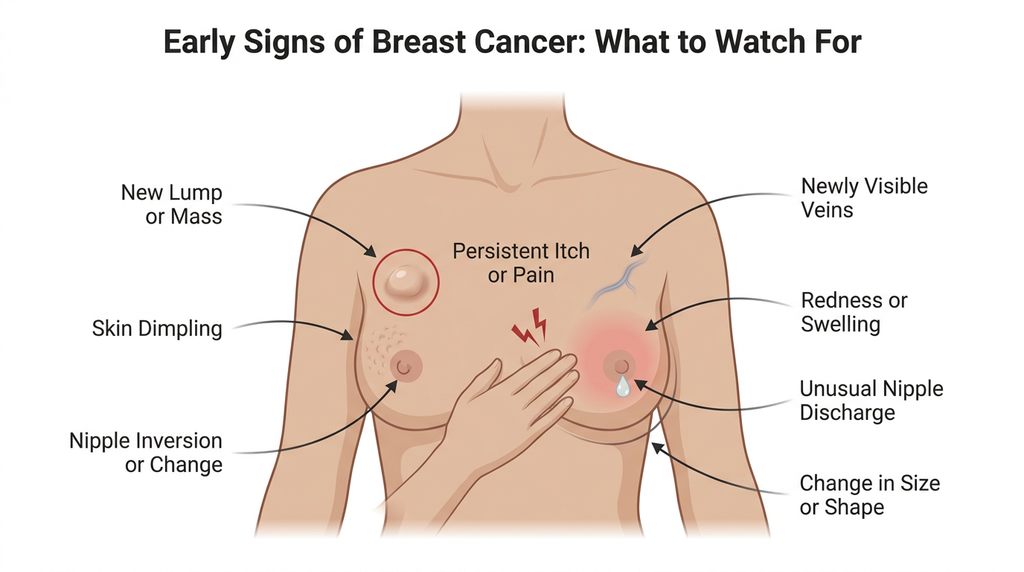
Breast cancer found early is far easier to treat, and the first person to notice a change is often you. Nearly 322,000 new cases of invasive breast cancer are expected in U.S. women in 2026, and cases in women under 50 have been creeping up by about 1.4% a year.
October is Breast Cancer Awareness Month, a good moment to learn what the early signs look and feel like. One thing to keep in mind throughout: most breast changes turn out to be benign. The goal isn’t to worry, it’s to notice, and to get anything new checked.
A new lump: the most common sign
The most common symptom of breast cancer is a new lump or mass in the breast or underarm. Most breast lumps are not cancer, but every new one deserves a look from a clinician.
Lumps that are more likely to be cancer tend to be:
- Hard, like a pebble, rather than rubbery or squishy
- Painless
- Irregular, with uneven edges
- Fixed in place rather than moving under your fingers
That profile is a tendency, not a rule. Some breast cancers are soft, rounded or tender, so a lump that doesn’t match the list still needs checking.
Changes in the breast and its skin
Not every breast cancer starts as a lump you can feel. Watch for these changes too:
- Swelling of all or part of a breast, even with no distinct lump
- Dimpling or puckering of the skin, sometimes described as looking like orange peel
- Redness, scaliness or thickening of the breast skin
- A change in size or shape of one breast that isn’t explained by your cycle, weight change or pregnancy
- New, persistent pain in one spot. Pain is not a common early sign, and most breast pain is hormonal, but pain that stays in one area and doesn’t come and go with your cycle is worth reporting.
Nipple changes
The nipple can show early signs too:
- Turning inward (retraction) when it used to point out. Retraction can also come with aging or benign conditions, so what matters is a new change.
- Discharge other than breast milk, especially if it is bloody, comes from one breast only, or appears without squeezing
- Redness, flaking, crusting or thickening of the nipple or areola
- Burning, itching or pain at the nipple. A rare form called Paget disease of the nipple often starts this way and can be mistaken for eczema.
A nipple rash that doesn’t clear up with ordinary treatment in a couple of weeks should be examined.
Signs beyond the breast
Breast cancer can spread to the lymph nodes under the arm or around the collarbone. A lump or swelling there can sometimes appear before a tumor in the breast is big enough to feel.
Inflammatory breast cancer is rare and behaves differently. Instead of a lump, the breast may turn red, swollen, warm and tender over days or weeks, often with orange-peel skin. It can look like a breast infection. If you’re treated for an infection and things don’t improve within about a week, go back and ask about this possibility, because it grows quickly and needs prompt treatment.
Men get breast cancer too. About 1% of breast cancers occur in men, and the signs are the same: a lump behind or near the nipple, nipple changes or discharge, and skin changes.
The earliest cancers have no signs at all
Many breast cancers cause no symptoms early on, which is why screening matters. A mammogram can find a cancer years before it can be felt, when treatment is usually simplest.
Major U.S. groups now agree most average-risk women should be able to start mammograms at 40, though they differ on how often:
| Organization | Start age (average risk) | How often |
|---|---|---|
| U.S. Preventive Services Task Force | 40 | Every 2 years |
| American College of Radiology and Society of Breast Imaging | 40 | Every year |
| American Cancer Society | Option at 40; yearly from 45 | Every year to 54, then every 1 to 2 years |
The confusion is real: in a 2026 Ohio State survey, 44% of women still thought screening starts at 50. It doesn’t.
If you have a strong family history, a known gene mutation such as BRCA1 or BRCA2, or prior chest radiation, you may need to start earlier, sometimes with MRI. Breast surgeons now suggest a formal risk assessment by about age 25. Most women diagnosed have no family history, so a clean family tree isn’t a reason to skip screening.
Know your normal
Mammograms don’t catch every cancer, so it helps to know how your breasts usually look and feel. Experts now favor this relaxed “breast self-awareness” over a rigid monthly exam routine.
- Get familiar. Notice your breasts in the shower or while dressing. Normal breast tissue is often lumpy; what you’re learning is your own baseline.
- Use the mirror. Look with arms down, then raised, for changes in shape, skin or nipples.
- Mind your cycle. Breasts often feel more tender or lumpy before a period. If you check deliberately, a week after your period starts is a good time.
- Compare over time, not to anyone else. One breast being slightly larger is normal. A new difference is what counts.
- Include the armpit and collarbone when you feel for changes.
When to see a doctor
Call your doctor if you notice any new change that lasts beyond one menstrual cycle, or any change at all if you’re past menopause. Don’t wait for your next routine visit, and don’t wait because the change doesn’t hurt.
A visit usually starts with a clinical breast exam, followed by a diagnostic mammogram, an ultrasound, or both. If something still looks uncertain, a needle biopsy gives a definite answer. Most of the time, the result is benign: a cyst, a fibroadenoma or normal tissue.
You know your body better than anyone. Noticing a change and getting it checked quickly is one of the most effective things you can do, and the peace of mind is worth the appointment.
This post is for general information and isn’t a substitute for advice from your own clinician.
Sources
- Breast Cancer Signs and Symptoms, American Cancer Society
- Breast Cancer Symptoms: What You Need to Know, American Cancer Society
- Signs and Symptoms of Breast Cancer, Breastcancer.org
- Conflicting mammogram guidelines may delay screening, WBRZ, May 2026
- Confusion continues over age to start screening, HealthDay, May 2026
- Overview of the 2026 ACP screening guidance, NEJM Journal Watch
- ASBrS Breast Cancer Screening Guidelines, American Society of Breast Surgeons, April 2026