
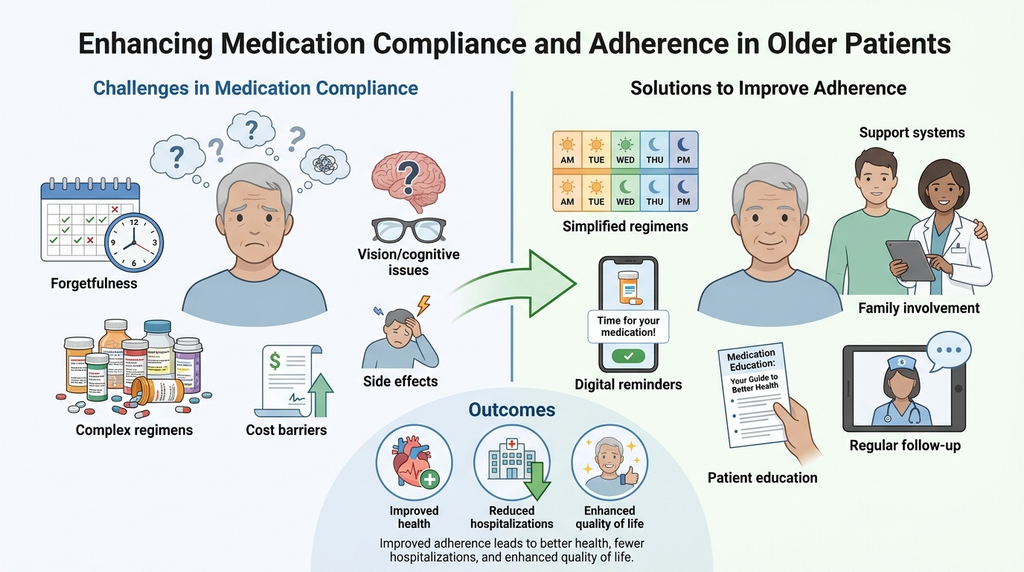
Taking medication exactly as prescribed sounds simple, but for many older adults, it’s one of the most challenging parts of managing their health. Studies consistently show that roughly half of older patients don’t take their medications as directed — a gap that contributes to hospitalizations, worsening chronic conditions, and billions of dollars in avoidable healthcare costs each year.
The good news is that non-adherence isn’t a character flaw or a sign of carelessness. It’s usually the predictable result of specific, fixable barriers. Understanding those barriers is the first step toward solving them.
Why Adherence Breaks Down in Older Adults
Several factors converge to make medication management harder with age:
- Polypharmacy. Many seniors manage five, ten, or more prescriptions from different specialists, each with its own dosing schedule.
- Cognitive changes. Mild memory lapses, and conditions like dementia, make it easy to forget a dose — or accidentally double one.
- Physical limitations. Poor vision can make small print on labels unreadable; arthritis or reduced dexterity can make childproof caps nearly impossible to open.
- Complex regimens. Some pills need to be taken with food, others on an empty stomach, some once daily, others three times — the mental math adds up fast.
- Cost concerns. Fixed incomes can force difficult choices, like skipping doses to make a prescription last longer.
- Side effects and skepticism. Unpleasant side effects, or simply not understanding why a medication matters, often lead people to quietly stop taking it.
- Social isolation. Patients living alone lack the natural reminders and support that come from a spouse or family member.
Recognizing which of these barriers is at play for a specific patient is essential — a solution that works for memory problems won’t help someone struggling with cost.
Practical Strategies That Make a Difference
1. Simplify the Regimen
Ask the prescribing doctor or pharmacist whether doses can be consolidated — for example, switching to once-daily formulations or aligning multiple medications to be taken at the same time of day. Fewer, simpler decisions mean fewer chances for error.
2. Use Pill Organizers and Blister Packs
Weekly or monthly pill organizers with clearly labeled compartments (morning, noon, evening, bedtime) let patients and caregivers see at a glance whether a dose has been taken. Pharmacy-provided blister packs go a step further, pre-sorting every dose in sequence.
3. Set Up Reminders
A simple phone alarm, a smart speaker reminder, or a dedicated medication reminder app can prompt patients at the right time. For those less comfortable with technology, a paper checklist taped to the fridge works just as well.
4. Involve Family and Caregivers
A daily check-in call, a shared reminder app, or a family member who helps refill the pill organizer each week can catch problems before they become dangerous. Caregivers are often the difference between a missed dose and a consistent routine.
5. Schedule Regular Medication Reviews
A pharmacist or physician should periodically review the full medication list — including over-the-counter drugs and supplements — to catch unnecessary duplicates, dangerous interactions, or medications that are no longer needed. This is especially important after a hospital stay or a new diagnosis.
6. Address Cost Openly
Patients often won’t volunteer that they’re skipping doses to save money. Asking directly, and connecting them with generic alternatives, patient assistance programs, or 90-day mail-order options, can remove this barrier entirely.
7. Make Instructions Clear and Accessible
Large-print labels, plain-language instructions (avoiding medical jargon), and easy-open bottle caps (when safe to use) go a long way. Written instructions should be paired with a verbal explanation, since information given only once, verbally, in a rushed appointment is easily forgotten.
8. Build Trust and Explain the “Why”
Patients are more likely to stick with a medication when they understand what it’s treating and what happens if they stop. A few minutes spent explaining purpose and consequences — and listening to concerns about side effects — builds the kind of trust that supports long-term adherence.
9. Screen for Depression and Isolation
Untreated depression is strongly linked to poor adherence in older adults. Routine screening, and connecting isolated patients with community resources or support groups, addresses a root cause that’s easy to overlook.
10. Leverage Technology Thoughtfully
Automatic pill dispensers that lock until the correct time, smart pillboxes that alert a caregiver if a dose is missed, and telehealth check-ins can all support adherence — but only if they match the patient’s comfort level with technology. The best tool is the one a patient will actually use.
A Team Effort
Improving medication adherence in older adults rarely comes down to a single fix. It works best as a coordinated effort between the patient, their family, their physician, and their pharmacist — each catching different pieces of the puzzle. Small, practical changes, like a labeled pill organizer or a weekly check-in call, often matter more than any high-tech solution.
Ultimately, the goal isn’t just to get pills taken on schedule. It’s to help older adults stay healthier, more independent, and more in control of their own care for as long as possible.