
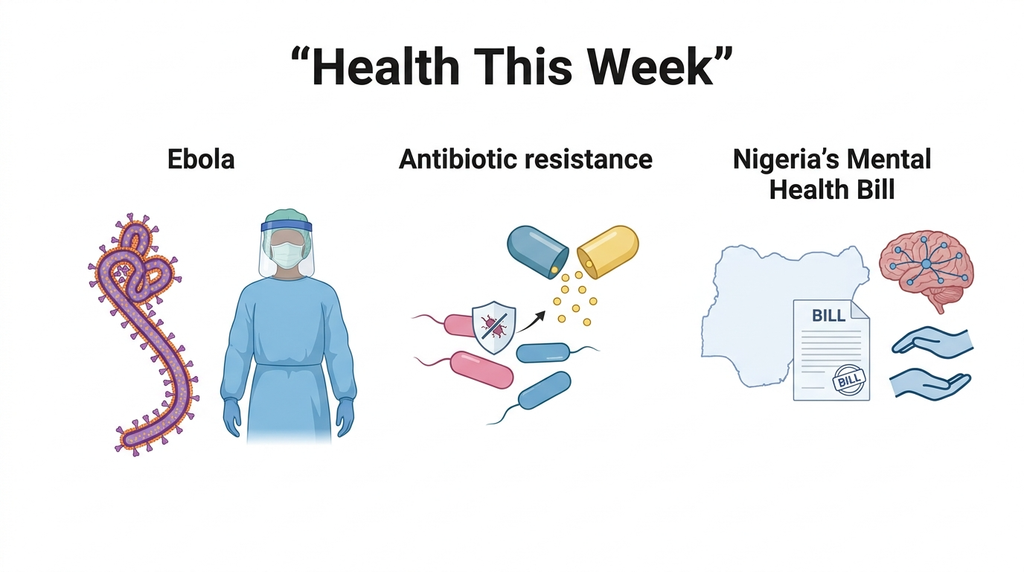
Nigeria has cleared every contact of its imported Ebola case with no new infections, the world is marking Antimicrobial Resistance Awareness Week, and the Senate now has a bill that would stop treating attempted suicide as a crime. Here are the health stories worth knowing this week.
1. Ebola: Nigeria holds the line as Congo’s outbreak hits six months
Nigeria has finished monitoring all 62 people who had contact with its imported Ebola case, and none of them caught the virus. The NCDC announced this on 13 November. The case was a Swiss woman who had travelled from Uganda to Abuja and tested positive on 20 October. She was evacuated to Geneva, where she recovered and left hospital on 11 November (Reuters via Devdiscourse).
During the 21 days, 13 contacts developed fever or similar symptoms, but all tested negative. Seven other Ebola alerts in five states were also negative (ThePrint/Reuters). NCDC Director-General Dr Jide Idris cautioned that this does not mean the outbreak is officially over. Nigeria must go 42 days without a new confirmed case before that can be declared (Africanews).
The source of the risk is the outbreak in the Democratic Republic of the Congo, caused by the Bundibugyo strain of Ebola. It reached six months on 15 November. Confirmed cases have passed 11,000, making it the second-largest Ebola outbreak on record, and there is still no approved vaccine or treatment for this strain. Africa CDC reports more than 5,400 deaths, along with armed attacks on responders and 11 health facilities burned or targeted.
There is some hope. WHO has recommended two vaccines designed specifically for Bundibugyo, Oxford’s ChAdOx1 BDBV (made with the Serum Institute of India) and Moderna’s mRNA-1469, for the Tumaini trial in Congo. It is the first time vaccines built for this strain will be tested during an outbreak (Gavi).
What it means for you: health workers should keep asking every patient with fever about recent travel, especially to East and Central Africa, and isolate early when in doubt.
2. World AMR Awareness Week: keep antibiotics working
World Antimicrobial Resistance Awareness Week runs from 18 to 24 November, with the theme “One Health, one action: Prevent AMR now” (WHO). Antimicrobial resistance happens when bacteria, viruses, fungi and parasites stop responding to the medicines meant to kill them. Drug-resistant bacteria are already linked to more than 4.7 million deaths a year (FAO). Without urgent action, AMR could cause up to 39 million deaths by 2050, with poorer countries hit hardest (WOAH).
This year’s campaign ties in with WHO’s updated Global Action Plan on AMR for 2026 to 2036, which sets targets to cut AMR deaths and reduce antibiotic use, especially in farming.
In Nigeria, buying antibiotics without a prescription and stopping a course early are common, and both drive resistance. Pharmacists and patent medicine vendors are on the front line. Simple habits help:
- Take antibiotics only when a doctor or other qualified prescriber says you need them.
- Finish the full course, even when you feel better.
- Never share leftover antibiotics or use someone else’s.
- Do not use antibiotics for colds and flu, which are caused by viruses.
- Wash hands, keep vaccinations up to date and handle food safely to avoid infections in the first place.
3. Nigeria moves to decriminalise attempted suicide
President Bola Tinubu has sent the Senate a bill that would stop treating attempted suicide as a crime (The Nigeria Brief). The National Mental Health Amendment Bill 2026 would change the 2021 National Mental Health Act to resolve its conflict with Nigeria’s criminal codes, which still punish people who try to end their lives.
Senate President Godswill Akpabio welcomed the bill on 17 November and sent it to the Committee on Rules and Business. He said the exemption would cover people who are “mentally disturbed”, a phrase that has raised questions about who decides who qualifies.
Mental health advocates have long argued that criminal penalties stop people from seeking help. If passed, the change would let doctors, nurses and families treat a suicide attempt as a health emergency rather than a police matter.
If you or someone you know is struggling, please reach out to a trusted person, a health worker or a local mental health helpline.
4. Resident doctors want arrears paid before Christmas
The Nigerian Association of Resident Doctors (NARD) is asking the federal government to clear what it still owes health workers before Christmas (allAfrica). Of 18 months of Professional Allowance Table arrears, only four have been paid, leaving 14 months outstanding. NARD wants President Tinubu to release the rest in one payment, along with delayed Batch 10 promotion arrears.
The association did thank the government for completing the 2026 Medical Residency Training Fund payments on 18 November. Pay disputes have led to strikes before, and with many doctors leaving the country, how this is handled matters for patients in public hospitals.
5. Climate change is a health issue: WHO’s six actions
A new WHO report says six climate and health measures could prevent about 1.6 million deaths a year, roughly one in every 40 deaths worldwide (Euronews). It was released ahead of the COP31 climate talks in Antalya, Türkiye. The six measures are:
- heat-health warning systems
- climate-resilient drinking water
- basic sanitation
- hygiene and handwashing facilities
- cleaner cooking and heating fuels
- better pricing of fossil fuels
Five of these would save about 360,000 lives a year at a cost of roughly $35 billion, returning about $24 for every dollar spent. Most of the remaining lives saved depend on removing fossil fuel subsidies and taxing coal, oil and gas more heavily (Health Policy Watch).
For Nigeria, clean water, sanitation and clean cooking fuel are directly linked to cholera, diarrhoea and lung disease from firewood and kerosene smoke.
6. Measles is back in the US, a warning for everyone
The United States is having its worst measles outbreak in decades. The US CDC reported 5,412 cases as of 12 November and six measles-related deaths this year, twice the 2025 total (Reuters via Devdiscourse). Pennsylvania alone has 1,542 confirmed cases and 305 hospitalisations. Measles had been declared eliminated in the US in 2000.
The lesson is that measles returns quickly when vaccination rates fall. Nigeria already carries a heavy burden: the NCDC confirmed 19,213 measles cases and 153 deaths between January and November 2025 (The Guardian Nigeria). Making sure every child gets both doses of the measles vaccine remains one of the best ways to protect them.
7. New obesity medicines in the spotlight
Obesity treatment continues to move fast. At ObesityWeek 2026 in Washington, D.C. (14 to 17 November), Eli Lilly presented new data on its weight-loss medicines (Lilly). In a phase 2 trial, its experimental combination EloraTZP lowered average blood sugar (A1C) by up to 2.9%, and up to 77% of participants reached normal blood sugar levels. Its experimental triple-hormone drug retatrutide also reduced sleep apnoea severity and knee arthritis pain in adults with obesity.
Separately, China approved Lilly’s GLP-1 weight-loss pill, the first time it has approved this class of drug as a tablet rather than an injection (Reuters via Devdiscourse).
Obesity, diabetes and high blood pressure are rising in Nigeria too. These medicines are not yet widely available or affordable here, so healthy diet, physical activity and regular blood pressure and sugar checks remain the first line of care.
Sources
- Reuters Health News Summary, 14 Nov 2026 (Devdiscourse)
- Nigeria ends 21-day Ebola contact monitoring (ThePrint/Reuters)
- Nigeria Ebola contacts complete monitoring (Africanews)
- Six months on, accessing hard-to-reach communities key to halting Ebola (UNICEF joint statement)
- Can two new vaccines help turn the tide against Bundibugyo Ebola? (Gavi)
- World AMR Awareness Week 2026 (WHO)
- World AMR Awareness Week 2026 (WOAH)
- The Nigeria Brief, 18 Nov 2026
- Resident doctors demand outstanding allowances before Christmas (allAfrica)
- Just six climate actions could save 1.6 million lives a year (Euronews)
- WHO’s trillion-dollar climate-health case (Health Policy Watch)
- Despite vulnerabilities, Nigeria’s health sector restructures for 2026 (The Guardian Nigeria)
- Lilly at ObesityWeek 2026 (Eli Lilly)