
You survived the diagnosis, the surgery, the hospital stay. So why does the smell of antiseptic still make your heart race?
Sometimes the hardest part of a medical crisis begins after it’s over. The scans are clear, the incision has healed, the discharge papers are in a drawer. But your body hasn’t gotten the message.
If you flinch at the sound of a beeping monitor, put off a checkup for years, or feel your chest tighten in a waiting room, you’re not being dramatic. You may be dealing with medical trauma, and you’re far from alone.
What medical trauma actually is
Medical trauma is the psychological and physical stress response that can follow frightening, painful, or overwhelming healthcare experiences. It isn’t limited to life-threatening emergencies. It can come from:
- A serious diagnosis or a long illness
- Emergency surgery or an ICU stay
- A traumatic birth or pregnancy loss
- Painful or invasive procedures
- Being dismissed, disbelieved, or talked over by providers
- Feeling powerless, restrained, or uninformed during care
- Watching someone you love go through any of the above
That last point matters. Caregivers and parents of sick children carry this too, and it often goes unrecognized.
Medical trauma isn’t a formal diagnosis on its own, but it can produce symptoms that look a lot like post-traumatic stress: intrusive memories or nightmares, avoiding appointments or anything that reminds you of the event, hypervigilance about your body, emotional numbness, irritability, or panic in medical settings.
The trauma is often not just what happened to you. It’s what happened without your control. Pain you couldn’t stop, information you didn’t get, decisions made around you instead of with you.
Why it lingers
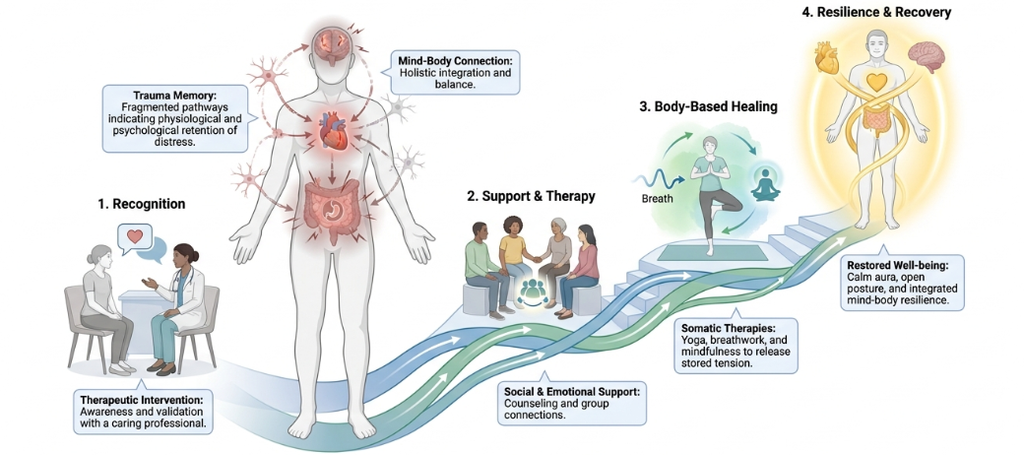
When your brain perceives a threat, it prioritizes survival over storytelling. Memories formed under extreme stress can be stored in fragments: a sound, a smell, a sensation, without a neat beginning and end. That’s why a hospital hallway can drop you back into the moment as if it’s happening now.
Your nervous system did its job. It just hasn’t learned that the danger has passed. Healing is largely about teaching it that.
Steps toward healing
1. Name it without minimizing it.
“Other people had it worse” is one of the most common ways people talk themselves out of getting help. Trauma isn’t a competition. If an experience overwhelmed your ability to cope, it counts.
2. Learn to steady your body first.
You can’t think your way out of a stress response that lives in your body. Simple grounding tools help in the moment:
- Slow your exhale. Breathe in for four counts, out for six to eight.
- Name five things you can see, four you can touch, three you can hear.
- Press your feet into the floor and notice the pressure.
- Hold something cold or textured to anchor yourself in the present.
These won’t cure trauma, but they give you a way back to the present when a memory hijacks you.
3. Look for trauma-informed support.
Talking with a therapist who understands trauma can make a real difference. Approaches with strong research support include trauma-focused cognitive behavioral therapy, EMDR (eye movement desensitization and reprocessing), and prolonged exposure therapy. Somatic approaches, which work with the body’s sensations directly, help many people as well. When you’re choosing a provider, it’s fine to ask, “Do you have experience with medical trauma or PTSD?”
4. Return to medical care in small, controlled steps.
Avoidance feels protective, but over time it can cost you your health and reinforce the fear. Instead of forcing yourself through a full appointment, try a gradual approach:
- Start by driving to the clinic and sitting in the parking lot.
- Schedule a phone call before an in-person visit.
- Book the first appointment of the day so you’re not waiting and worrying.
- Bring a trusted person and agree on a signal for when you need a pause.
5. Reclaim your voice in the exam room.
Much medical trauma is rooted in lost control, so rebuilding it matters. You’re allowed to:
- Ask what will happen before it happens
- Request that a provider explain each step
- Say “stop” or “I need a moment”
- Ask for a different provider if you don’t feel safe
- Write your questions down and bring them
Some people find it helpful to tell the care team upfront: “I have a history of medical trauma. It helps me a lot if you tell me what you’re doing before you do it.” A good provider will hear that as useful information, not a difficulty.
6. Make room for grief and anger.
Medical trauma often carries losses: your health, your sense of safety, a version of your life you expected. Anger at the system, at a missed diagnosis, or at your own body is a normal part of processing. Journaling, creative work, or talking with people who’ve been through something similar can help you give those feelings somewhere to go.
7. Rebuild trust with your body.
After a health crisis, many people feel betrayed by their bodies. Gentle movement, restful sleep, time outdoors, and nourishing routines can slowly change the relationship from my body failed me to my body carried me through. Go at a pace that feels kind rather than punishing.

What healing looks like
Healing rarely means the memory disappears. It means the memory loses its grip. You can think about what happened without your heart pounding. You can walk into a clinic and feel nervous but not flooded. You can make health decisions from a place of choice instead of fear.
It’s usually not a straight line. Anniversaries, new symptoms, or even a TV hospital scene can stir things up again. That doesn’t mean you’ve lost your progress. It means your system is still learning, and you have more tools now than you did before.
A final word
If your symptoms are intense, if you’re having trouble functioning day to day, or if you ever feel hopeless, please reach out to a mental health professional or your doctor. You deserve support, and asking for it is a sign of strength, not weakness.
What happened to you was real. Your reactions make sense. And with time, support, and patience, your body can learn that it’s safe again.
If you’ve experienced medical trauma, what helped you? Share in the comments. Your words might be exactly what someone else needs to read tonight.