Sep 25, 2026 · @AUGUSTINE
Why 25 September matters
Today, 25 September 2026, pharmacists around the world are being recognised for work that most of us rely on without a second thought. World Pharmacists Day is the one day each year set aside to thank the professionals who make sure every medicine we take is the right one, at the right dose, used the right way.
Think about the last time you picked up a prescription, asked about a cough syrup, or got a flu shot at your local pharmacy. Behind each of those moments was a pharmacist checking for dangerous interactions, answering questions and quietly keeping you safe. For millions of people, the pharmacist is the most accessible health professional they will see all year, with no appointment needed.
At PharmaHub, we believe this day deserves more than a social media post. In this article we look at where World Pharmacists Day came from, what this year’s theme means, how pharmacists benefit patients and health systems, and how everyone can take part.
A brief history of World Pharmacists Day
World Pharmacists Day was created by the International Pharmaceutical Federation (FIP) at its Council meeting in Istanbul in 2009. Its purpose is simple: to encourage activities that promote and advocate for the pharmacist’s role in improving health in every corner of the world.
The date was not chosen at random. 25 September marks the anniversary of FIP’s founding in 1912, more than a century ago. Today FIP is in official relations with the World Health Organization and, through about 160 member organisations, represents more than 5.5 million pharmacists and pharmaceutical scientists worldwide.
Since 2009 the day has grown from a professional observance into a global campaign. Each year FIP sets a theme, releases campaign materials in multiple languages and invites pharmacy associations, schools, hospitals and community pharmacies to run their own events. It is now complemented by World Pharmacy Week (19 to 25 September), which celebrates the whole pharmacy workforce, including pharmaceutical scientists, educators, technicians and students.
| Year | Milestone |
|---|---|
| 1912 | FIP founded on 25 September |
| 2009 | World Pharmacists Day established at the FIP Council in Istanbul |
| 2026 | Theme: “Empowering pharmacists for healthier futures” |
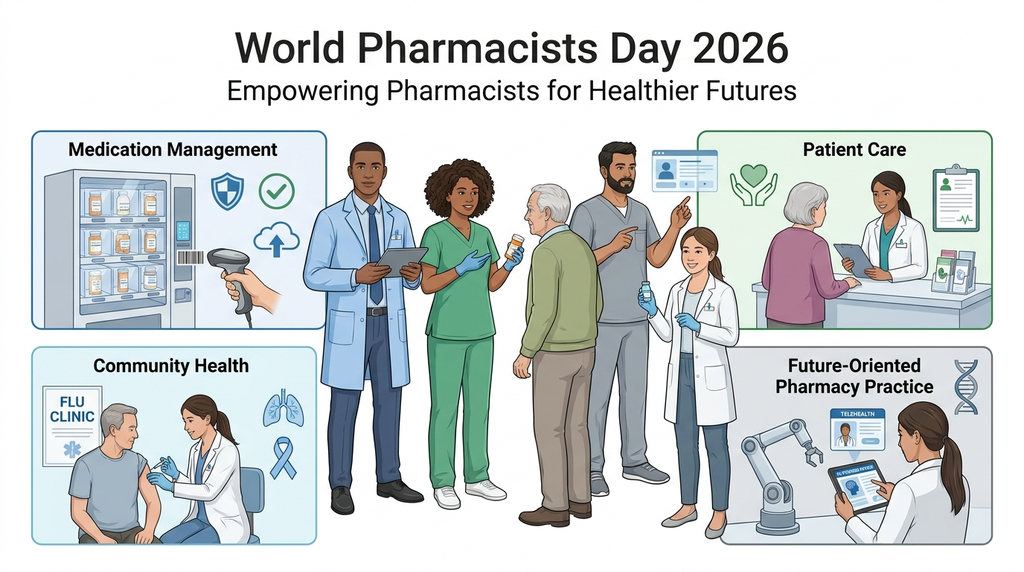
The 2026 theme: “Empowering pharmacists for healthier futures”
FIP announced this year’s theme in March 2026. It focuses on four areas where pharmacists make a critical difference: prevention, access to care, health system resilience and sustainability.
The theme is also a call to action. FIP is urging governments, policymakers, regulators, health insurers and the public to support pharmacists through better policies, investment in education and full integration into health systems. FIP president Paul Sinclair summed it up by describing empowerment as giving pharmacists the competencies, recognition and working environments they need to meet changing health needs.
Why now? Healthcare is being reshaped by forces that put pharmacists at the centre:
- Ageing populations who take more medicines for longer
- Rising noncommunicable diseases such as diabetes, heart disease and hypertension
- Digital transformation, from e-prescribing to telepharmacy and AI tools
- Climate-related pressures that disrupt supply chains and shift disease patterns
The message of 2026 is that appreciation alone is not enough. Pharmacists need the training, legal scope, recognition and team role that allow them to use their full expertise. Empowering the profession is not optional; it is essential to building health systems ready for the future.
Countries are adapting the theme locally. In India, for example, the Pharmacy Council of India is marking the day under the global theme with a national focus on combating antimicrobial resistance (AMR).
The many roles of today’s pharmacist
The old picture of a pharmacist “counting pills behind a counter” is decades out of date. Today’s pharmacists are highly trained medicine experts who work across the entire healthcare system.
| Setting | What pharmacists do |
|---|---|
| Community pharmacy | Dispense and review prescriptions, counsel patients, give vaccinations, screen for blood pressure and diabetes, advise on minor ailments, support smoking cessation |
| Hospital and clinical pharmacy | Round with medical teams, adjust doses in intensive care, manage antibiotics, prevent medication errors, reconcile medicines at admission and discharge |
| Industry and research | Discover and develop new medicines, run clinical trials, ensure manufacturing quality, monitor drug safety |
| Regulation and public health | Approve and monitor medicines, run pharmacovigilance programmes, lead vaccination and awareness campaigns |
| Academia | Educate the next generation of pharmacists and advance pharmaceutical science |
| Digital and telepharmacy | Provide remote consultations, manage e-prescriptions, build safer medication software |
Across every setting, one thread connects them: pharmacists are the reason people get the most from their medicines. They sit at the intersection of medicine supply, scientific innovation and patient care, a position no other health professional occupies in quite the same way.
How World Pharmacists Day benefits everyone
World Pharmacists Day is not just a celebration for pharmacists. The awareness it creates brings real benefits to patients, communities, health systems and the profession itself.
1. Benefits for patients
- Safer medicine use. The day reminds people that pharmacists are there to answer questions. Patients who ask are less likely to take a wrong dose, mix risky medicines or stop treatment early.
- Better adherence. Many people do not take long-term medicines as prescribed. Pharmacist counselling helps patients understand why a medicine matters, which improves control of conditions like diabetes, asthma and hypertension.
- Awareness of services. Many patients still do not know their pharmacist can vaccinate, check blood pressure, review all their medicines or advise on minor illnesses. Campaigns on this day spread that knowledge.
- Empowered patients. Knowing you can ask a free, qualified expert without an appointment puts people in control of their own health.
2. Benefits for communities and public health
- Access close to home. In rural areas and underserved neighbourhoods, the pharmacy is often the only health service within reach.
- Prevention. Pharmacy-based vaccination, health screening and lifestyle advice catch problems early, before they turn into hospital admissions.
- Fighting antimicrobial resistance. Pharmacists promote responsible antibiotic use and educate the public that antibiotics do not cure viral infections like colds and flu.
- Emergency readiness. The COVID-19 pandemic showed that pharmacies stay open, test, vaccinate and advise when other services are stretched. The day keeps that lesson alive.
3. Benefits for health systems
- Reduced pressure on doctors and emergency departments. When pharmacists manage minor ailments and routine checks, doctors have more time for complex cases.
- Fewer medication errors. Pharmacist review in hospitals and at discharge catches errors before they harm patients, avoiding costly readmissions.
- Cost savings. Better adherence, fewer adverse drug events and appropriate generic substitution all reduce healthcare spending.
- Resilience. A well-integrated pharmacy workforce helps systems absorb shocks, from pandemics to medicine shortages.
4. Benefits for the pharmacy profession
- Recognition and morale. Pharmacists often work long hours under pressure. Public appreciation matters.
- Advocacy. The day gives associations a platform to push for expanded scope of practice, fair pay and safe staffing.
- Inspiring future pharmacists. Students see the breadth of the career and the difference it makes.
- Global solidarity. Pharmacists in over a hundred countries share ideas, campaigns and best practice on the same day.
Challenges pharmacists face, and what empowerment looks like
The 2026 theme exists because pharmacists often cannot use their full skills. Common barriers include:
- Workforce shortages and burnout from heavy workloads and understaffing
- Limited scope of practice, where laws stop pharmacists from prescribing, vaccinating or managing chronic conditions they are trained for
- Funding models that pay for dispensing volume rather than clinical care
- Weak integration with doctors and hospitals, including no access to shared patient records
- Low public awareness of what pharmacists can actually do
Empowering pharmacists means tackling these barriers directly:
- Education and lifelong learning so pharmacists keep pace with new therapies, digital tools and clinical services.
- Expanded, clearly defined scope of practice, backed by regulation, so skills are not wasted.
- Fair payment for clinical services such as medication reviews, vaccination and chronic disease support.
- Full integration into care teams, with shared records and collaborative practice with doctors and nurses.
- Recognition and safe working conditions that protect wellbeing and keep talented people in the profession.
When these pieces are in place, the whole system gains. Patients get faster help, doctors get a trusted partner and health budgets go further.
How to celebrate and get involved
Everyone has a part to play, whether you wear the white coat or not.
If you are a patient or member of the public
- Say thank you to your local pharmacist, in person or with a note or review.
- Book a medication review, especially if you take several medicines.
- Ask your pharmacist which services they offer, from vaccinations to health checks.
- Share a story of a pharmacist who helped you, using #WorldPharmacistsDay and #WPD2026.
If you are a pharmacist
- Run a free health screening or medicine-safety awareness session in your pharmacy.
- Visit a school or community group to talk about safe medicine use and antibiotics.
- Mentor a pharmacy student or early-career colleague.
- Use FIP’s official campaign materials, available in Arabic, Chinese, English, French, Russian and Spanish.
If you are a pharmacy student or educator
- Organise quizzes, poster competitions, health camps or rallies on campus.
- Host a panel with pharmacists from community, hospital, industry and regulatory careers.
If you are a policymaker or employer
- Review what stops pharmacists in your system from working at the top of their training.
- Invest in continuing education, safe staffing and pay models that reward clinical care.
Conclusion: a thank-you from PharmaHub
Pharmacists are among the most trusted and accessible health professionals in the world. They catch the error before it reaches the patient, answer the late-night question, give the vaccine and explain the new prescription one more time. Much of that work happens quietly, which is exactly why World Pharmacists Day matters.
This year’s theme, “Empowering pharmacists for healthier futures”, reminds us that gratitude should lead to action. When pharmacists are properly trained, recognised, funded and integrated into care teams, patients live healthier lives and health systems grow stronger.
To every pharmacist, pharmacy technician, student, scientist and educator in the PharmaHub community: thank you. Happy World Pharmacists Day 2026.
Share this post with a pharmacist who has made a difference in your life, and tag them with #WorldPharmacistsDay.