
Breast cancer is more than a medical diagnosis written on a laboratory report.
For many people, the words “you have breast cancer” can instantly change the way they see their future. It can bring fear, confusion, questions about family, concerns about body image, worries about finances, and uncertainty about treatment. For families, it can mean sleepless nights, hospital visits, difficult conversations, and sometimes profound grief.
Yet breast cancer is also a disease in which early detection, accurate diagnosis, advances in treatment, and supportive care can make a major difference.
Breast cancer occurs in virtually every country and can affect women at different stages of life. Men can also develop breast cancer, although it is much less common. According to the World Health Organization (WHO), an estimated 2.4 million women were diagnosed with breast cancer and approximately 694,000 died from the disease globally in 2024. WHO also emphasizes that about 80% of breast cancers occur in women without a specific risk factor other than sex and age. World Health Organization
That last point is particularly important.
A woman does not have to have a mother, sister, or aunt with breast cancer to develop it. She does not have to “live an unhealthy life.” And having no family history does not guarantee protection.
Breast cancer is complex.
Understanding it is one of the most important steps we can take toward earlier diagnosis, better treatment, and better outcomes.
What Exactly Is Breast Cancer?
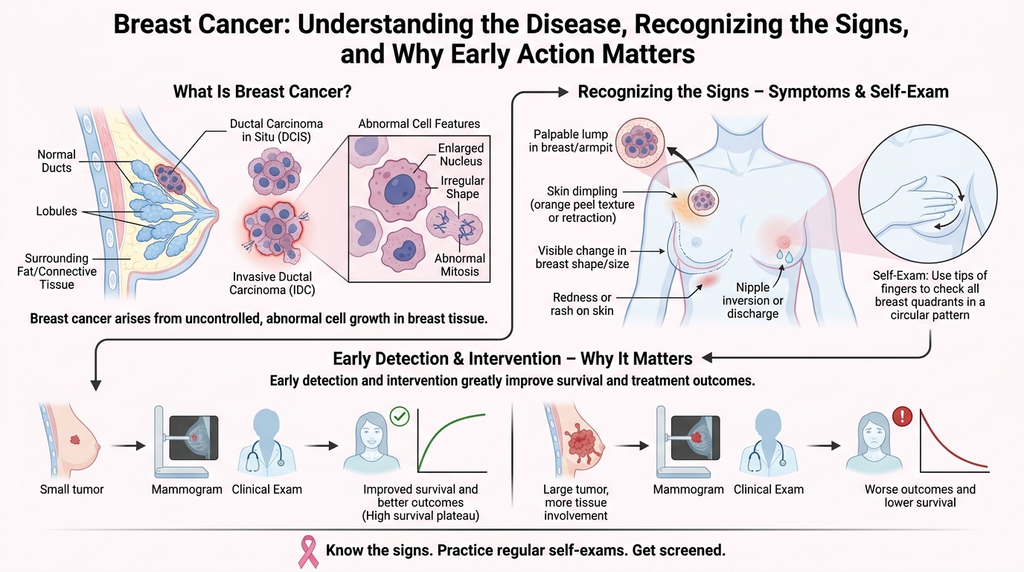
Breast cancer occurs when abnormal cells in breast tissue begin to grow and divide in an uncontrolled way.
Normally, cells grow, divide, perform their functions, and eventually die when they are no longer needed. This process is carefully regulated by the body.
Cancer develops when genetic and molecular changes disrupt those controls.
Abnormal breast cells may continue multiplying, forming a mass or tumor. Some cancers remain confined to the tissue where they began, while others invade surrounding tissue and can eventually spread to lymph nodes or distant organs.
Breast cancer commonly begins in cells lining the milk ducts or in the milk-producing lobules. World Health Organization
There are many different forms of breast cancer, which is why it is inaccurate to think of breast cancer as a single disease.
Two broad categories are particularly important:
1. Non-invasive breast cancer
In non-invasive disease, abnormal cells remain confined to their original location.
One example is ductal carcinoma in situ (DCIS), in which abnormal cells are found within the lining of the milk ducts but have not invaded surrounding breast tissue.
DCIS is not the same thing as invasive breast cancer, although it can develop into invasive disease and therefore requires appropriate medical evaluation and management. Cancer.gov
2. Invasive breast cancer
In invasive breast cancer, cancer cells have moved beyond their original location into surrounding breast tissue.
The most common invasive breast cancer is invasive ductal carcinoma, which begins in the cells lining the milk ducts and spreads beyond them. Another important type is invasive lobular carcinoma, which begins in the milk-producing lobules. Cancer.gov
Once cancer becomes invasive, it can potentially enter lymphatic or blood vessels and travel to other parts of the body.
When breast cancer spreads to distant organs, it is called metastatic or stage IV breast cancer.
Breast Cancer Is Not Only a Lump
One of the most persistent misconceptions about breast cancer is that the disease always begins with a noticeable lump.
It does not.
Some breast cancers can be detected through screening before a person notices any physical change. Mammography, for example, can identify abnormalities before symptoms appear. Cancer.gov
Other cancers may produce noticeable changes.
Possible warning signs include:
- A new lump in the breast
- Thickening in part of the breast
- A change in breast size or shape
- Skin dimpling
- Skin redness or unusual changes in texture
- Changes around the nipple
- Nipple inversion that is new
- Unusual nipple discharge, particularly bloody discharge
- Persistent swelling
- A lump or swelling in the armpit
- Persistent changes that are different from what is normal for you
WHO specifically identifies breast lumps or thickening, changes in breast size or appearance, dimpling or redness of the skin, nipple changes, and abnormal or bloody nipple discharge among possible symptoms. World Health Organization
But there is an equally important message:
A breast lump does not automatically mean cancer.
Many breast lumps are benign.
Fibroadenomas, cysts, infections, hormonal changes and other conditions can cause breast abnormalities.
The problem is that you cannot reliably determine the cause of a new breast lump simply by touching it.
That is why an unusual change deserves medical assessment rather than self-diagnosis.
Does Breast Cancer Hurt?
Sometimes.
But breast cancer does not necessarily cause pain, especially in its early stages.
This is one reason the statement:
“It doesn’t hurt, so it can’t be cancer.”
is dangerous.
A painless lump can still require evaluation.
Conversely, breast pain is commonly caused by conditions other than cancer.
The important question is not simply whether something hurts.
The important question is:
Is there a new or unusual change that needs to be evaluated?
Who Can Develop Breast Cancer?
Breast cancer predominantly affects women, but men can develop it too.
WHO estimates that approximately 99% of breast cancers occur in women, while approximately 0.5–1% occur in men. World Health Organization
Breast cancer risk generally increases with age.
However, younger women can also develop breast cancer.
This is particularly important in communities where breast cancer is sometimes assumed to be an illness of older women only.
A young woman who notices a persistent breast abnormality should not automatically dismiss it because of her age.
What Causes Breast Cancer?
This is one of the hardest questions to answer because there is usually no single cause.
Cancer develops through a complex interaction of:
- Genetic changes
- Aging
- Hormonal influences
- Reproductive factors
- Environmental exposures
- Lifestyle factors
- Inherited genetic predisposition
- Random cellular changes
Some risk factors are modifiable.
Others are not.
And sometimes breast cancer develops without an obvious explanation.
That is why blaming someone for developing cancer is both scientifically inappropriate and emotionally harmful.
Major Risk Factors for Breast Cancer
1. Age
Age is one of the strongest risk factors for breast cancer.
As cells accumulate genetic changes over time, the probability of cancer increases.
This does not mean younger people are immune.
It means risk generally increases with age.
2. Family history
Having close relatives with breast cancer can increase risk.
However, most women diagnosed with breast cancer do not have a known family history of the disease. World Health Organization
This is an important distinction.
A woman should not ignore symptoms simply because:
“Nobody in my family has had breast cancer.”
Family history is relevant, but its absence does not eliminate risk.
3. Inherited Genetic Mutations
Some people inherit genetic variants that significantly increase their risk of breast cancer.
Important genes include:
- BRCA1
- BRCA2
- PALB2
Other genes can also contribute to hereditary breast cancer syndromes.
Genetic testing may be recommended for certain people depending on factors such as age at diagnosis, family history, cancer characteristics, ancestry, and personal medical history.
Genetic counseling can help patients understand what testing means before and after testing.
It is important to remember that:
Having a genetic mutation does not mean a person definitely has cancer.
It means the person’s risk may be substantially higher than average.
4. Alcohol
Alcohol consumption is associated with increased breast cancer risk.
This is one reason public-health recommendations often encourage limiting alcohol consumption.
Risk is not necessarily an all-or-nothing phenomenon.
In other words, the conversation should not be reduced to:
“You drink, therefore you will get cancer.”
Cancer biology is far more complicated.
5. Excess body weight after menopause
Being overweight or obese after menopause is associated with increased breast cancer risk.
Adipose tissue is biologically active and can influence hormone metabolism, inflammation, insulin signaling, and other pathways relevant to cancer biology.
This is one reason maintaining a healthy weight is often included among strategies for reducing cancer risk.
6. Physical inactivity
Regular physical activity is associated with a lower risk of breast cancer.
Exercise also contributes to cardiovascular health, metabolic health, mental health and overall well-being.
Physical activity should therefore be viewed as part of general health rather than as a guaranteed method of preventing cancer.
7. Hormonal and reproductive factors
Breast tissue responds to hormones, particularly estrogen and progesterone.
Certain reproductive and hormonal patterns can influence lifetime exposure to these hormones.
Risk can also be influenced by factors such as:
- Age at first menstrual period
- Age at first pregnancy
- Menopausal status
- Certain forms of hormone therapy
- Other reproductive factors
These factors do not mean that pregnancy, menstruation, or menopause “causes” cancer.
They are simply associated with differences in breast cancer risk.
8. Previous radiation exposure
Exposure to radiation involving the chest, particularly at a younger age, can increase breast cancer risk.
For example, some people who received radiation therapy for childhood or young-adult cancers may require specialized breast cancer surveillance later in life.
9. Tobacco use
Smoking is associated with numerous cancers and other diseases, and tobacco exposure has also been associated with breast cancer risk.
Avoiding tobacco remains one of the most important actions a person can take for overall health.
Why Family History Is Not the Whole Story
Imagine two women.
One has several relatives who have had breast cancer.
The other has no known family history.
It would be incorrect to conclude that the first woman will develop cancer and the second woman will not.
Cancer risk is probabilistic, not deterministic.
Some people with strong family histories never develop breast cancer.
Others develop breast cancer despite having no known affected relatives.
This is why both risk assessment and awareness matter.
Breast Cancer in Men
Breast cancer is much less common in men, but it is real.
Because breast cancer is often culturally associated with women, men may overlook breast symptoms or feel embarrassed to seek medical care.
A man who develops:
- A breast lump
- Nipple changes
- Nipple discharge
- Skin changes
- Swelling around the breast or nipple
should seek medical evaluation.
Male breast cancer is uncommon, but uncommon does not mean impossible. Cancer.gov
What Happens When Someone Finds a Breast Lump?
The first step should not be panic.
The first step should be evaluation.
A healthcare professional may ask about:
- The location of the lump
- How long it has been present
- Whether it is changing
- Pain or tenderness
- Nipple changes
- Menstrual or reproductive history
- Family history
- Previous breast problems
- Medications and hormone exposure
A physical examination may follow.
Depending on age, symptoms and clinical circumstances, imaging may include:
Mammography
A mammogram uses low-dose X-rays to produce images of the breast.
It can be used for screening and diagnostic evaluation. Cancer.gov
Ultrasound
Breast ultrasound uses sound waves to create images of breast tissue.
It can be particularly useful for evaluating a palpable abnormality and distinguishing certain cystic and solid findings.
MRI
Breast MRI uses a magnetic field and radio waves to produce detailed images.
It may be used in specific diagnostic situations and for screening some people at high risk. Cancer.gov
The Biopsy: The Test That Answers the Big Question
Imaging can identify an abnormality.
But imaging alone does not always establish whether a lesion is cancer.
When breast cancer is suspected, a biopsy may be performed.
During a biopsy, a sample of cells or tissue is removed and examined by a pathologist.
The pathologist studies the tissue under a microscope and produces a pathology report.
A biopsy is the definitive method used to establish a diagnosis of breast cancer in the appropriate clinical setting. Cancer.gov
This is why someone should not conclude:
“My mammogram showed something, so I definitely have cancer.”
An abnormal mammogram is not synonymous with a cancer diagnosis.
Understanding Breast Cancer Biomarkers
Modern breast cancer treatment is increasingly personalized.
Two women can both have breast cancer but receive very different treatments because their tumors have different biological characteristics.
Important biomarkers include:
Estrogen receptor (ER)
Some breast cancers use estrogen signaling to grow.
These cancers are called ER-positive.
Hormonal therapies may be used to interfere with that signaling.
Progesterone receptor (PR)
Tumors may also be assessed for progesterone receptor expression.
HER2
HER2 is a protein involved in cell growth.
Some breast cancers have increased HER2 expression or amplification.
These cancers are called HER2-positive and may respond to HER2-targeted therapies.
Triple-negative breast cancer
Triple-negative breast cancers lack estrogen receptors, progesterone receptors and HER2 overexpression/amplification.
Because hormone therapy and HER2-targeted therapy do not target these features, treatment strategies are different.
This illustrates a fundamental principle of modern oncology:
Breast cancer treatment is increasingly based on the biology of the tumor, not simply where the tumor is located.
NCI notes that breast cancers are tested for biomarkers such as estrogen receptors, progesterone receptors and HER2 because this information helps guide staging and treatment decisions. Cancer.gov
What Does “Stage” Mean?
When someone hears:
“What stage is the cancer?”
they are asking about how far the cancer has progressed.
Staging considers factors such as:
- Tumor size
- Lymph-node involvement
- Whether the cancer has spread to distant organs
- Tumor characteristics
- Biomarkers
- Other clinical and pathological information
Broadly:
Stage 0
Abnormal cells remain confined to their original location, as in DCIS.
Stages I–III
These generally represent invasive cancers with varying degrees of local and regional involvement.
Stage IV
The cancer has spread to distant parts of the body.
Importantly, stage IV does not mean that medical care stops.
Treatment may focus on controlling the cancer, reducing symptoms, preserving function, extending life, and maintaining quality of life.
How Is Breast Cancer Treated?
There is no single breast cancer treatment.
Treatment depends on:
- Cancer type
- Stage
- Biomarkers
- Tumor characteristics
- Overall health
- Menopausal status
- Pregnancy status when relevant
- Genetic information
- Previous treatments
- Patient preferences
Many people receive combinations of therapies. Cancer.gov
1. Surgery
Surgery may involve removing the tumor while preserving much of the breast, commonly called lumpectomy, or removing most/all of the breast tissue, called mastectomy.
Surgery may also involve evaluation of nearby lymph nodes.
The appropriate surgical approach depends on the individual cancer and clinical circumstances.
2. Radiation Therapy
Radiation therapy uses high-energy radiation to destroy cancer cells or reduce the risk of cancer returning in treated areas.
Radiation may be recommended after surgery in certain circumstances.
It is a localized treatment, meaning its primary effect is directed toward the treatment area. Cancer.gov
3. Chemotherapy
Chemotherapy uses drugs that kill cancer cells or interfere with their ability to grow and divide.
Chemotherapy can be given:
- Before surgery
- After surgery
- For advanced disease
Importantly:
Not everyone with breast cancer needs chemotherapy.
Treatment decisions depend on tumor biology, stage and other factors.
NCI specifically notes that chemotherapy is not required for every person with breast cancer. Cancer.gov
4. Hormone Therapy
Hormone therapy may be used when breast cancer cells depend on hormones such as estrogen or progesterone for growth.
Examples of endocrine treatments include medications that block hormone receptors or reduce estrogen production.
These treatments can play an important role in reducing the risk of recurrence in hormone-receptor-positive breast cancer.
5. Targeted Therapy
Targeted therapies are designed to interfere with specific molecular pathways or proteins that cancer cells depend on.
One important example is treatment targeting HER2 in HER2-positive breast cancer.
This is one of the major ways modern oncology has moved toward precision medicine.
Instead of treating every breast cancer in exactly the same way, clinicians increasingly ask:
What biological characteristics make this particular tumor grow?
6. Immunotherapy
Immunotherapy helps the immune system recognize and attack cancer.
It can be used in selected patients, including some people with triple-negative breast cancer.
However, immunotherapy is not appropriate for every breast cancer patient. Cancer.gov
7. Clinical Trials
Clinical trials are an important part of cancer research.
They may investigate:
- New drugs
- New combinations of existing treatments
- New immunotherapies
- New targeted therapies
- New surgical approaches
- New diagnostic technologies
- Strategies for reducing recurrence
For some patients, participation in a clinical trial may provide access to treatments that are not yet widely available.
Clinical trials should always be discussed with an oncology team to determine eligibility and potential benefits and risks.
What About Alternative Medicine?
This is an area where patients deserve honesty rather than judgment.
People facing cancer may hear claims about:
- Special diets
- Herbal preparations
- Supplements
- Detoxification
- Fasting
- Essential oils
- “Natural cures”
- Unproven cancer treatments
Some complementary approaches may help with symptoms or quality of life when used appropriately.
But there is a major difference between:
supportive complementary care
and
replacing evidence-based cancer treatment with an unproven therapy.
A person should discuss supplements, herbs and alternative treatments with their healthcare team because some products can interact with cancer medications or affect surgery, bleeding, liver function, kidney function or other aspects of treatment.
A natural substance is not automatically a safe substance.
Breast Cancer Screening: Why It Matters
Screening means looking for cancer before symptoms develop.
That distinction is important.
Screening is not the same thing as investigating a lump.
The purpose of screening is to identify disease earlier, when treatment may be more effective.
Mammography remains the standard screening test for most women, although recommendations vary according to age, risk level, country and guideline organization. Cancer.gov
For example, in the United States, the CDC currently notes that the U.S. Preventive Services Task Force recommends mammography every two years for women aged 40–74 who are at average risk. Individual recommendations can differ for people with higher-than-average risk. CDC
Therefore, screening should not be reduced to one universal rule for every woman everywhere.
Your healthcare professional can help determine the appropriate schedule based on your age and risk profile.
What About Breast Self-Examination?
Breast awareness is important.
People should become familiar with how their breasts normally look and feel and should pay attention to new or unusual changes.
However, breast self-examination by itself is not considered an adequate substitute for recommended breast cancer screening. Cancer.gov
The message should therefore be:
Know your breasts, but do not rely on self-examination alone.
Breast Cancer and Pregnancy
Breast cancer can occur during pregnancy, although it is uncommon.
Pregnancy can make breast examination more complicated because hormonal changes naturally alter breast tissue.
A persistent or concerning breast change during pregnancy should still be evaluated.
Pregnancy does not mean:
“Nothing can be done.”
There are specialized approaches to evaluating and treating breast cancer during pregnancy, and decisions should be made by an experienced multidisciplinary medical team.
Breast Cancer and Breastfeeding
Breastfeeding is associated with some reduction in breast cancer risk, but it does not eliminate the possibility of developing breast cancer.
A breastfeeding woman can still develop a breast lump or other breast abnormality.
Lactational changes, blocked ducts, mastitis and benign conditions can also cause breast symptoms.
Therefore, a persistent or concerning abnormality during breastfeeding deserves medical assessment.
The Global Breast Cancer Problem
One of the most important aspects of breast cancer is that access to diagnosis and treatment is not equal around the world.
A person living in a high-income country may have relatively easy access to:
- Mammography
- Ultrasound
- Pathology
- Immunohistochemistry
- Genetic testing
- Oncology specialists
- Radiation therapy
- Targeted therapy
- Clinical trials
- Reconstructive surgery
Someone living in a low-resource setting may encounter:
- Limited screening programs
- Long travel distances
- Diagnostic delays
- Lack of pathology services
- Medication shortages
- High treatment costs
- Limited oncology specialists
- Fear and stigma
- Traditional beliefs
- Late presentation
These differences can profoundly affect outcomes.
WHO reports major inequalities in breast cancer outcomes between countries with different levels of human development. World Health Organization
This is why breast cancer should not be viewed solely as a biological problem.
It is also a health-system problem.
Breast Cancer in Africa: The Importance of Early Diagnosis
Across many African settings, breast cancer can present at relatively advanced stages.
There are multiple reasons.
Some patients may not recognize early warning signs.
Others may recognize a lump but delay seeking care because of:
- Fear
- Cost
- Stigma
- Misinformation
- Transportation problems
- Reliance on traditional remedies
- Previous negative experiences with healthcare systems
- Lack of nearby diagnostic facilities
- Fear of mastectomy
- Fear of chemotherapy
This is why education matters.
But education alone is not enough.
Telling people to “get screened” is meaningless if there is no accessible pathway from screening to diagnosis and treatment.
A functioning breast cancer program needs a continuum:
Awareness → Detection → Diagnosis → Pathology → Staging → Treatment → Follow-up → Survivorship/Palliative care
If one part collapses, the entire system suffers.
The Nigerian Perspective
Breast cancer is an important public-health issue in Nigeria.
For many Nigerian families, the challenge is not simply discovering a breast lump.
The challenge can be everything that happens afterward.
A patient may need to navigate:
- Primary healthcare
- Specialist referral
- Imaging
- Biopsy
- Histopathology
- Immunohistochemistry
- Surgery
- Chemotherapy
- Radiation
- Follow-up
- Medication costs
- Transportation
- Family responsibilities
- Employment
- Emotional stress
The financial burden can become enormous.
For some families, a cancer diagnosis affects not only the patient but the economic stability of the entire household.
This is why strengthening cancer services requires more than building hospitals.
It requires investment in:
- Cancer awareness
- Primary healthcare
- Diagnostic laboratories
- Pathology services
- Imaging
- Oncology training
- Affordable medicines
- Radiation facilities
- Cancer registries
- Research
- Palliative care
- Patient navigation
- Mental-health support
The Emotional Side of Breast Cancer
Cancer treatment is not only physical.
A person may experience:
- Fear
- Anxiety
- Depression
- Anger
- Isolation
- Uncertainty
- Financial stress
- Changes in body image
- Sexual health concerns
- Relationship difficulties
- Fear of recurrence
Breast cancer can be particularly emotionally challenging because the breasts may be closely connected with identity, femininity, sexuality, motherhood and body image.
Surgery can therefore affect a person psychologically even when the operation is medically successful.
Some patients experience grief after mastectomy.
Others struggle with hair loss from chemotherapy.
Some feel uncomfortable seeing their bodies after treatment.
Others worry about whether their partners will still find them attractive.
These concerns are not superficial.
They are part of the human experience of cancer.
Survivorship: Life After Treatment
Finishing treatment does not necessarily mean everything immediately returns to normal.
Survivors may experience:
- Fatigue
- Neuropathy
- Hormonal changes
- Lymphedema
- Menopausal symptoms
- Sexual-health concerns
- Fertility concerns
- Anxiety about recurrence
- Financial problems
- Changes in work or family responsibilities
Survivorship care therefore matters.
Cancer care should not end simply because the chemotherapy infusion has finished.
What Is Lymphedema?
Some breast cancer patients develop lymphedema, a condition in which lymph fluid accumulates and causes swelling, commonly in the arm on the side of treatment.
It can occur after lymph-node surgery or radiation.
Early recognition and appropriate management can help reduce complications and improve quality of life.
Patients should report persistent swelling, heaviness, tightness or changes in the affected arm to their healthcare team.
The Fear of Recurrence
One of the most difficult psychological experiences after breast cancer treatment can be the fear that the cancer will return.
A routine scan.
A headache.
A new ache.
A follow-up appointment.
Even small physical changes can trigger anxiety.
This is sometimes described as fear of recurrence.
Patients may benefit from structured follow-up, clear communication with their healthcare team, psychological support, and knowing which symptoms require medical attention.
Breast Cancer Does Not Define the Person
A patient is not:
“the cancer patient.”
She is still a mother.
A daughter.
A sister.
A spouse.
A scientist.
A teacher.
A pharmacist.
A business owner.
A student.
A friend.
A human being with dreams that existed before the diagnosis and can continue afterward.
Healthcare professionals should treat the disease while remembering the person.
Common Myths About Breast Cancer
Myth 1: “If there is no family history, I cannot get breast cancer.”
False.
Most women diagnosed with breast cancer do not have a known family history. World Health Organization
Myth 2: “A painful lump is cancer.”
Not necessarily.
Many benign breast conditions cause pain or tenderness.
Myth 3: “A painless lump is harmless.”
False.
Breast cancer can present as a painless lump.
A new lump should be evaluated.
Myth 4: “Only older women get breast cancer.”
False.
Risk increases with age, but younger women can develop breast cancer.
Myth 5: “Men cannot get breast cancer.”
False.
Men can develop breast cancer, although it is uncommon. World Health Organization
Myth 6: “Mammograms cause breast cancer.”
Mammography uses low-dose X-rays, and radiation exposure is one consideration in discussions about screening. However, mammography is an established breast cancer screening tool, and screening can help detect cancer earlier. Cancer.gov
The benefits and potential harms of screening should be discussed according to individual risk.
Myth 7: “If I have breast cancer, I will definitely die.”
False.
Breast cancer is not one disease with one outcome.
Prognosis varies considerably depending on cancer type, stage, biology, treatment response and other factors.
Early detection and appropriate treatment can improve outcomes. World Health Organization
Myth 8: “Chemotherapy is the only treatment.”
False.
Treatment can include surgery, radiation therapy, hormone therapy, chemotherapy, targeted therapy and immunotherapy, depending on the cancer. Cancer.gov
Can Breast Cancer Be Prevented?
There is no guaranteed way to prevent every case of breast cancer.
However, certain strategies can reduce risk.
These include:
- Maintaining a healthy body weight
- Engaging in regular physical activity
- Avoiding tobacco
- Limiting alcohol
- Discussing hormone therapy risks and benefits with a healthcare professional
- Breastfeeding when possible and desired
- Understanding personal and family history
- Considering genetic counseling when appropriate
- Following recommended screening guidelines
- Seeking prompt evaluation of unusual breast changes
WHO emphasizes that many breast cancers occur without a specific modifiable risk factor beyond sex and age. World Health Organization
So prevention should never become blame.
A person can do everything “right” and still develop cancer.
The Role of Men in Breast Cancer Awareness
Breast cancer awareness should not be treated as exclusively a women’s issue.
Men can:
- Encourage women in their families to seek medical attention
- Support partners during treatment
- Accompany relatives to appointments
- Help with transportation
- Assist with childcare
- Provide emotional support
- Challenge cancer stigma
- Understand that men themselves can develop breast cancer
Sometimes the most powerful support is simply saying:
“You don’t have to go through this alone.”
What Families Can Do After a Diagnosis
When someone you love is diagnosed with breast cancer, avoid immediately overwhelming them with stories from the internet.
Instead:
Listen.
Let them express fear without immediately trying to “fix” it.
Help practically.
Offer transportation, meals, childcare or help with appointments.
Respect their decisions.
Treatment decisions should be made with the patient and qualified healthcare professionals.
Avoid miracle cures.
Do not pressure someone into abandoning evidence-based treatment.
Ask what they need.
Sometimes they need information.
Sometimes they need company.
Sometimes they need silence.
Sometimes they simply need someone to sit beside them.
What Should You Do If You Notice a Breast Change?
Do not panic.
Do not ignore it.
Do not spend weeks trying to diagnose yourself on social media.
Instead:
1. Take note of the change.
2. Arrange an appointment with an appropriate healthcare professional.
3. Follow through with recommended imaging or testing.
4. If a biopsy is recommended, understand why it is being performed.
5. If cancer is diagnosed, ask about the type, stage and biomarkers.
6. Discuss treatment options with your oncology team.
7. Ask questions about side effects, costs, fertility, work and quality of life.
8. Seek emotional and social support.
Questions to Ask Your Doctor After a Breast Cancer Diagnosis
A cancer diagnosis can make it difficult to think clearly.
Writing questions down before appointments can help.
Consider asking:
- What type of breast cancer do I have?
- Is it invasive or non-invasive?
- What stage is it?
- What is the tumor grade?
- Is it ER-positive or ER-negative?
- Is it PR-positive or PR-negative?
- Is it HER2-positive or HER2-negative?
- Has it spread to lymph nodes?
- Has it spread elsewhere?
- Do I need genetic testing?
- Do I need surgery?
- Will I need chemotherapy?
- Will I need radiation?
- Would hormone therapy help?
- Are targeted therapies appropriate?
- Is immunotherapy appropriate?
- What side effects should I expect?
- Could treatment affect fertility?
- What will treatment cost?
- Are there financial assistance programs?
- Are clinical trials available?
- What happens after treatment?
There is no such thing as a “stupid” question when your health is involved.
The Future of Breast Cancer Research
Breast cancer research is moving rapidly.
Scientists are studying:
- Tumor genetics
- Immunotherapy
- Antibody-drug conjugates
- Molecularly targeted therapies
- Liquid biopsy
- Artificial intelligence in imaging
- Precision oncology
- Cancer vaccines
- Drug resistance
- Tumor microenvironment
- New approaches to metastatic disease
- Prevention in high-risk individuals
- Better ways to identify patients who need chemotherapy
- Better ways to identify patients who may safely avoid unnecessary treatment
The goal is increasingly not simply:
“How do we treat breast cancer?”
but:
“How do we treat this particular breast cancer in this particular person as effectively and safely as possible?”
That is the promise of precision medicine.
Breast Cancer and Artificial Intelligence
Artificial intelligence is also entering breast cancer care.
AI-based systems are being investigated and used in areas such as:
- Mammographic image analysis
- Detection of suspicious lesions
- Risk prediction
- Pathology
- Radiology workflows
- Treatment planning
- Drug discovery
- Clinical decision support
But AI should complement—not replace—qualified healthcare professionals.
A computer can identify patterns.
It does not replace the human conversation surrounding diagnosis, treatment preferences, family circumstances, ethics and quality of life.
The Most Important Message: Do Not Wait for Pain
Breast cancer does not always announce itself dramatically.
Sometimes there is no pain.
Sometimes there is no obvious lump.
Sometimes there are no symptoms at all.
That is why awareness, appropriate screening, timely evaluation and access to treatment are so important.
At the same time, we should not turn breast cancer awareness into constant fear.
The goal is not to make people afraid of every change in their bodies.
The goal is to make people informed enough to recognize when something deserves attention.
A Message to Anyone Currently Facing Breast Cancer
If you are reading this after receiving a breast cancer diagnosis, you may currently be overwhelmed.
You may not know what the pathology report means.
You may be frightened about surgery.
You may be thinking about your children.
You may be worried about money.
You may be wondering whether your life will ever feel normal again.
Take the process one step at a time.
First understand the diagnosis.
Then understand the stage.
Then understand the biology of the cancer.
Then understand the available treatment options.
You do not need to understand your entire cancer journey in one afternoon.
Ask questions.
Take notes.
Bring someone you trust to appointments when possible.
Get a second opinion when appropriate.
Tell your healthcare team about medications, supplements and traditional remedies you are using.
And most importantly, remember that a cancer diagnosis is not the same thing as a prediction of your entire future.
Final Thoughts
Breast cancer is a disease of cells, genes, hormones, tissues and molecular pathways—but behind every diagnosis is a person.
The scientific advances in breast cancer have been extraordinary. We now understand far more about the disease than previous generations did. We have surgery, radiation, chemotherapy, endocrine therapy, targeted therapy, immunotherapy, molecular testing and increasingly sophisticated approaches to precision medicine. Cancer.gov
But scientific progress alone is not enough.
A woman cannot benefit from an advanced cancer therapy if she cannot afford it.
A patient cannot receive targeted treatment if the tumor cannot be properly tested.
A screening program cannot save lives if there is no pathway to diagnosis and treatment.
And awareness cannot succeed if fear, stigma and misinformation prevent people from seeking care.
The fight against breast cancer therefore requires science, healthcare access, early detection, compassionate care, research, education and community support.
Perhaps the most important lesson is simple:
Know what is normal for your body. Pay attention to unusual changes. Follow appropriate screening recommendations. Seek medical evaluation when something concerns you. And never let fear or misinformation make the decision for you.
Breast cancer is serious.
But serious does not mean hopeless.
And awareness is not about living in fear.
It is about giving people the knowledge and opportunity to act early.
This article is for health education and does not replace an examination, diagnosis, or individualized medical advice from a qualified healthcare professional.