
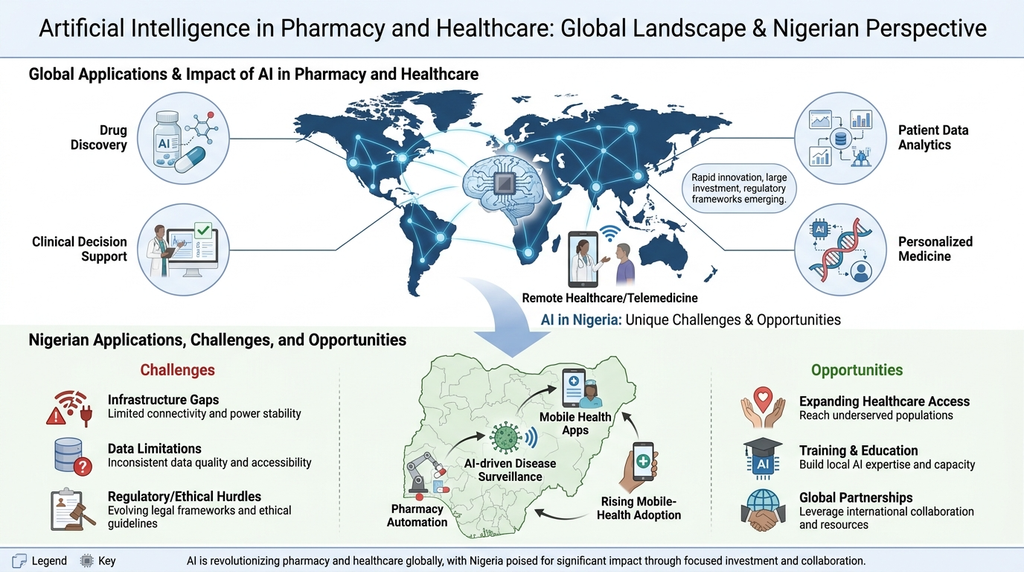
Artificial intelligence is changing how medicines are discovered, how patients receive care, and how health systems make decisions. Its greatest value will come from helping health professionals work more accurately and reach more people while keeping patients safe.
Imagine a pharmacist reviewing a prescription for a patient who takes several medicines. The pharmacist must consider the dose, possible interactions, kidney function, allergies, and whether the patient can obtain and use the medicine as directed. An artificial intelligence (AI) system could bring relevant information to the pharmacist’s attention within seconds. It might identify an unusual dose or flag a combination that deserves closer review.
That speed is useful, but it does not settle the clinical question. The pharmacist still needs to determine whether the alert applies to this patient, speak with the patient or prescriber when necessary, and make a professional decision. This balance between computational support and human judgment defines the most promising role of AI in pharmacy and healthcare.
Around the world, AI is being explored in drug discovery, diagnostic imaging, clinical documentation, medication safety, disease surveillance, and hospital operations. In Nigeria, these possibilities meet a distinct set of needs: improving access to trustworthy health information, strengthening medicine supply chains, supporting health workers, and making better use of health data. They also meet practical constraints involving infrastructure, affordability, privacy, and the quality of available data.
What does AI mean in healthcare?
AI is a broad term for computer systems that perform tasks commonly associated with human reasoning, such as recognizing patterns, interpreting language, making predictions, or generating text. Different kinds of AI serve different purposes.
A machine learning model might estimate the likelihood of a patient developing a complication from patterns in past data. An image analysis system might highlight an area of concern on a scan. A generative AI tool might draft a patient information leaflet or summarize a lengthy medical record.
These systems do not all have the same level of evidence, reliability, or regulatory oversight. A tool that helps organize stock in a pharmacy presents different risks from one that recommends treatment. The more directly an AI system influences patient care, the more carefully its performance and use must be assessed.
AI in the discovery and development of medicines
Developing a medicine requires years of research. Scientists must understand a disease, identify a biological target, find a promising compound, test its properties, and evaluate its safety and effectiveness. AI can assist at several points in this process.
In early research, computational models can help scientists examine biological data, identify possible drug targets, predict how molecules may interact with those targets, and prioritize compounds for laboratory testing. In formulation research, models may help investigators study how ingredients and manufacturing conditions affect a medicine’s properties. Researchers can also use AI to analyze large sets of clinical or real-world data and generate questions for further study.
This can make research more focused. A laboratory may be able to test a better selected group of candidates instead of treating every possible compound as equally promising. Yet a computer prediction is only a starting point. A predicted molecule must still be synthesized, characterized, tested, and evaluated in appropriate studies. AI cannot turn an unverified hypothesis into an approved medicine by itself.
Regulators are paying attention to how these tools are used. The US Food and Drug Administration issued draft guidance in 2025 on assessing AI models used to produce information intended to support regulatory decisions about drug and biological product safety, effectiveness, or quality. The document’s draft status matters: it provides a proposed approach, rather than a blanket endorsement of AI-generated evidence. (FDA)
For Nigerian researchers and pharmaceutical manufacturers, AI offers opportunities in locally relevant work: studying diseases that affect the population, investigating natural products with rigorous methods, improving formulation development, and analyzing manufacturing data. The strongest projects will begin with a clear scientific question and follow predictions with sound experiments.
AI in everyday pharmacy practice
The pharmacy is one of the places where AI’s benefits could become most visible to patients. Pharmacists already combine clinical information, medicine knowledge, patient preferences, and practical access concerns. Well-designed tools can help them find relevant information and spend more time on the decisions and conversations that require professional expertise.
Prescription review and medication safety
An AI-supported system may identify possible drug interactions, duplicate therapies, unusual doses, allergy concerns, or gaps in monitoring. It may also help prioritize alerts so that the most urgent issues receive attention first.
The challenge is context. An alert might be clinically important for one patient and less relevant for another. If a system produces too many low-value warnings, staff may begin to overlook them. Safe use therefore requires both technical validation and a workflow that lets pharmacists review the underlying information.
Counseling and patient education
Generative AI can help draft plain-language explanations of how to take a medicine, what to do after a missed dose, and which symptoms should prompt medical attention. It may also help prepare information in different languages or at different reading levels.
Every such explanation needs checking before it reaches a patient. A fluent answer can still omit an essential warning or give advice that is inappropriate for a particular product. Pharmacists must also account for the patient’s actual circumstances, including other medicines, pregnancy, age, and the ability to follow the proposed schedule.
Supporting long-term treatment
For people living with conditions such as hypertension, diabetes, asthma, or HIV, digital tools may help organize refill reminders, identify missed follow-up appointments, and support regular communication. AI could help a care team identify patients who may need extra attention.
A reminder alone does not explain why someone has missed treatment. The cause might be cost, adverse effects, travel, misunderstanding, or an unavailable medicine. Meaningful support still depends on asking the patient and addressing the real barrier.
Stock and supply management
Pharmacies and hospitals can use predictive tools to estimate demand, monitor expiry dates, and identify unusual stock patterns. Better forecasts may reduce waste and help facilities prepare for changing needs.
This is particularly relevant where interruptions in medicine supply can force patients to travel between facilities or delay treatment. A forecast, however, is only as dependable as its inventory records and assumptions. Local purchasing patterns, seasonal disease changes, and sudden shortages can all affect its accuracy.
AI in diagnosis and clinical care
AI can help clinicians interpret complex information, but its usefulness depends on the specific task and setting. One comparatively concrete example is tuberculosis screening. The World Health Organization (WHO) has recommended computer-aided detection software for specified uses in interpreting digital chest X-rays for TB screening and triage. A screening result still requires the appropriate clinical pathway and confirmatory testing; it is not, by itself, a definitive diagnosis. (who.int)
Other possible applications include highlighting findings on medical images, organizing patient histories, identifying people who may need closer monitoring, and reducing time spent on routine documentation. These uses vary widely in maturity. A tool that performs well in one hospital may perform differently in another because patients, equipment, data quality, and clinical practices differ.
That issue has global importance. Models developed mainly with data from well-resourced health systems may need additional testing before they are used elsewhere. Local validation should examine who benefits, who may be missed, how often errors occur, and what clinicians can do when the system is wrong.
Pharmacovigilance: finding medicine safety problems sooner
A medicine’s safety continues to be monitored after it reaches the market. Pharmacovigilance involves detecting, assessing, understanding, and preventing adverse effects and other medicine-related problems. (Regulation and Prequalification)
AI could support this work by sorting large numbers of safety reports, detecting duplicate submissions, identifying patterns that deserve review, or extracting relevant details from free-text descriptions. Those functions could help safety teams focus their time. An AI-generated signal, however, is a reason to investigate. It does not prove that a medicine caused an event.
For Nigeria, stronger reporting remains fundamental. NAFDAC provides channels for reporting suspected adverse drug reactions, including reporting through health professionals and its established reporting processes. More sophisticated analysis will be useful only if suspected reactions are documented and submitted in the first place. (nafdac.gov.ng)
A practical goal would be to make reporting easier for pharmacists, clinicians, and patients, then use carefully assessed tools to help reviewers manage the information. The human steps of checking a report, assessing causality, and deciding on action remain essential.
Public health and health-system planning
AI may also help health authorities examine trends across facilities and communities. Potential uses include estimating medicine demand, identifying unusual disease patterns, planning outreach, and directing limited resources where they are most needed.
These possibilities depend on dependable underlying systems. Incomplete records can produce misleading forecasts. Data collected from urban hospitals may fail to represent rural communities. A sophisticated model cannot compensate for missing patients, inconsistent definitions, or weak reporting practices.
Nigeria’s Digital in Health Initiative aims to develop a national digital health architecture. That kind of groundwork matters because connected, well-governed systems can make health information more useful across points of care. In September 2026, Nigeria’s Federal Ministry of Health and Social Welfare also emphasized interoperability, cybersecurity, data protection, ethical AI, and patient confidentiality as priorities for digital health implementation. (policy)
What AI could mean for Nigerian pharmacy and healthcare
Nigeria should approach AI as a set of tools for specific health problems, rather than as a single solution to the health system’s challenges. Several areas deserve particular attention.
Access to reliable medicine information. People frequently need clear answers about how to use prescribed medicines, recognize adverse effects, and know when to seek professional care. Carefully reviewed digital information could help extend the reach of pharmacists. It should identify its limits and direct people to a qualified professional when their situation requires individual assessment.
Support for health workers. A well-designed system could help a pharmacist or clinician retrieve relevant guidance, organize documentation, or identify a concern for review. It should fit the realities of the setting, including workload, available equipment, and connectivity.
Medicine availability. Better inventory records and demand estimates could help facilities plan purchases and reduce avoidable stockouts or expiry. This may be a more immediate and measurable use of AI than a complex diagnostic chatbot.
Research and local innovation. Nigerian universities, hospitals, pharmacists, software developers, and manufacturers can collaborate on tools built around local questions. Locally developed work should still meet high standards for testing, security, clinical oversight, and transparent reporting.
Digital pharmaceutical services. Nigeria unveiled an e-pharmacy regulatory framework in 2026 covering the registration, licensing, operation, and oversight of digital pharmaceutical services. This makes safe digital pharmacy practice a timely issue. AI features added to such services should preserve professional accountability and appropriate controls over prescriptions and dispensing. (fmino.gov.ng)
The country’s National Artificial Intelligence Strategy provides broader policy context for developing AI, including the need to consider rights, infrastructure, and public benefit. Its promise in healthcare will depend on turning broad ambitions into tools that work safely for actual patients and health workers. (fmcide.gov.ng)
The risks cannot be treated as an afterthought
Healthcare decisions can have serious consequences. An incorrect answer about a medicine may lead to harm even when it sounds confident and well written. WHO has called for caution in the use of large language models in health and has published guidance on their ethics and governance. (who.int)
Several risks need attention wherever AI is used.
Incorrect or invented information
Generative tools can produce false statements, nonexistent references, or convincing explanations based on a mistaken premise. Users should be able to trace clinically significant claims to reliable sources, and qualified professionals should review outputs before they inform care.
Bias and unequal performance
If a model is trained or tested on a narrow population, it may work less well for others. Evaluation should consider different patient groups and care settings. In Nigeria, that means asking whether evidence from another country is relevant locally and whether people outside large urban facilities are adequately represented.
Privacy and security
Health information is deeply personal. Clinics, pharmacies, and technology providers need clear rules about what information is collected, who may access it, where it is stored, and how long it is retained. Nigeria’s Data Protection Act 2023 provides a legal framework for protecting personal data, including sensitive personal data. (ndpc.gov.ng)
A practical safeguard is simple: staff should not paste identifiable patient records into an unapproved public AI tool merely to obtain a quick summary or answer.
Overreliance
A busy professional may be tempted to accept a recommendation without checking it, especially when it arrives in a polished format. Systems should make their purpose and limits clear. Organizations should train users to recognize when an output requires verification or escalation.
Cost and unequal access
AI systems need maintenance, training, and often reliable electricity or connectivity. If only well-funded facilities can use them, existing gaps in care may widen. Nigerian deployments should be evaluated for their total cost and their performance in the facilities and communities they are intended to serve.
A practical path to responsible adoption
The best way forward is to start with a defined problem and measure whether a tool improves it.
A hospital pharmacy, for example, could test whether an AI-assisted stock forecast reduces expiry and shortages. A research group could evaluate whether a model improves the selection of formulation experiments. A public health program could assess a screening tool within its full referral and confirmation pathway. Each project should define success before deployment and check for unintended harm afterward.
For healthcare organizations, a responsible approach includes five steps:
- Choose a clear use case. Identify the decision or task the tool is meant to support and who remains responsible for it.
- Test with relevant data and users. Include the patients, facilities, languages, and conditions in which the tool will actually operate.
- Protect information. Apply appropriate privacy, security, and access controls.
- Keep a review pathway. Make it possible for qualified staff to question, correct, or override an output.
- Measure results over time. Track patient safety, accuracy, workload, cost, and whether performance differs between groups.
Pharmacists have an important role in every step involving medicines. Their expertise in dosing, interactions, formulation, adherence, counseling, and medicine safety can help developers ask better questions and help health systems judge whether an AI tool is genuinely useful.
The future is a stronger partnership between people and technology
AI can help people process information at a scale and speed that would otherwise be difficult. It may make research more efficient, bring concerns to a clinician’s attention sooner, improve pharmacy operations, and help health systems see patterns in their data. These are valuable possibilities for the world and for Nigeria.
The measure of progress, however, is not the number of AI tools deployed. It is whether patients receive safer care, health workers can make better decisions, and communities that have been underserved see real benefits. Achieving that requires credible evidence, local testing, accountable professionals, and public trust.
The most useful question for pharmacy and healthcare in this era of AI is therefore straightforward: Does this tool help us care for people better, and can we show that it does?