
Breast health is an important part of overall health, and knowing what is normal for your breasts can help you recognize changes early. One simple habit that can help is breast self-awareness—regularly paying attention to how your breasts normally look and feel so that you can identify changes that may require medical evaluation.
Finding a lump in your breast can be frightening. However, it is important to understand that most breast lumps are not cancerous. Breast tissue can naturally feel lumpy or uneven, and benign conditions such as cysts, fibroadenomas, hormonal changes, and infections can cause lumps.
Nevertheless, a new or unusual breast change should not be ignored. Knowing how to examine your breasts and when to seek professional care can make an important difference.
What Is Breast Self-Awareness?
Breast self-awareness means becoming familiar with the normal appearance and feel of your breasts.
Rather than performing a formal breast self-examination on a strict schedule, many healthcare organizations emphasize knowing your breasts and reporting new or unusual changes to a healthcare professional.
Breasts can naturally change throughout the menstrual cycle, during pregnancy, breastfeeding, menopause, and with changes in hormones or medications. Therefore, it is useful to understand what is normal for you.
Breast self-awareness applies to everyone—not only women. Men can also develop breast conditions, including breast cancer, although breast cancer is much less common in men.
Why Should You Check Your Breasts?
Breast cancer is one of the most common cancers affecting women worldwide. Early detection can provide an opportunity for earlier diagnosis and treatment.
Checking your breasts does not mean that you can diagnose breast cancer yourself. A lump or other breast change can have many causes.
Instead, the goal is to recognize something that is different from your normal breast tissue and have it appropriately evaluated.
When Is the Best Time to Check Your Breasts?
If you menstruate, your breasts may become swollen, tender, or lumpy at certain times of your menstrual cycle.
For this reason, some people find it easier to become familiar with their breasts by checking them when they are less tender, often several days after their menstrual period begins or ends, depending on their individual cycle.
If you do not menstruate, choose a regular time that is convenient for you.
The most important thing is consistency and familiarity, rather than a particular day of the month.
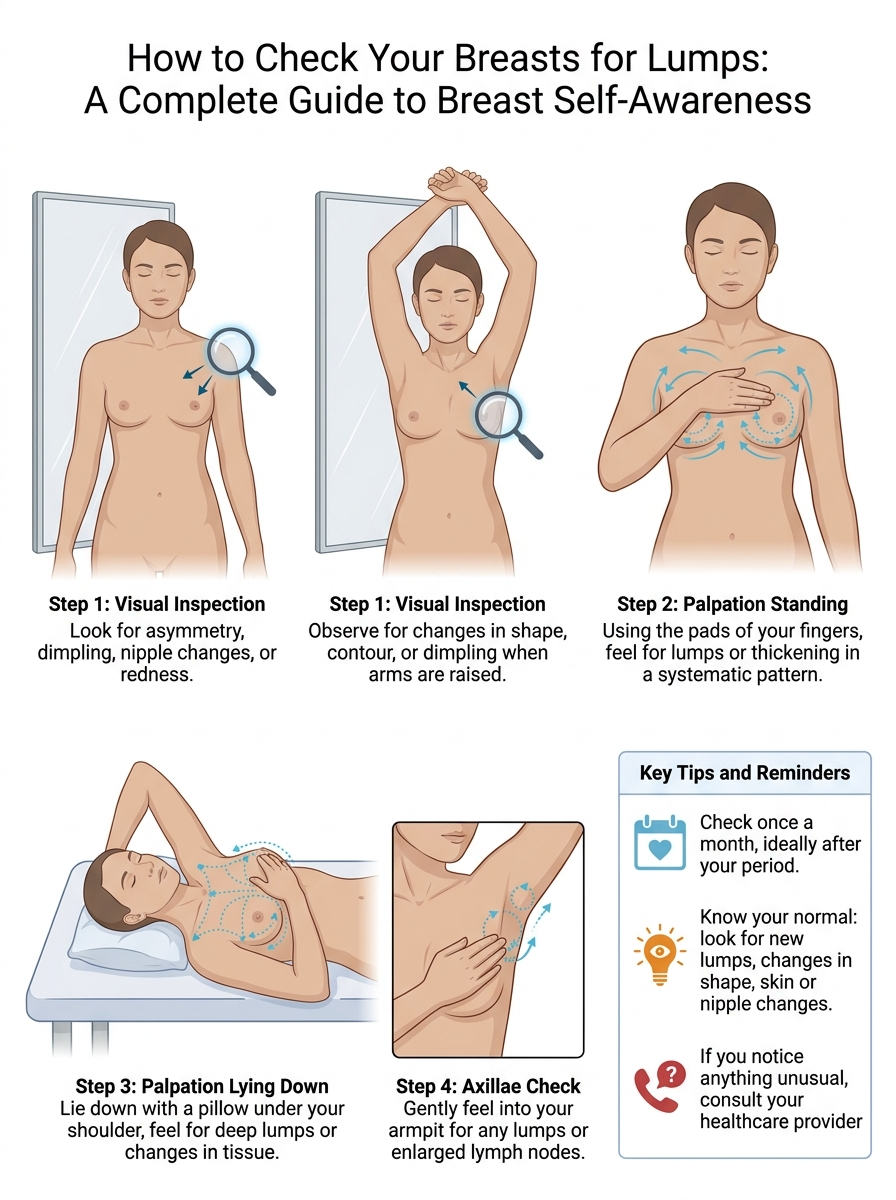
Step 1: Look at Your Breasts
Begin by standing in front of a mirror with your upper body exposed.
Keep your arms relaxed at your sides and look carefully at both breasts.
Look for changes such as:
- A new change in breast size or shape
- New asymmetry that wasn’t previously present
- Skin dimpling or puckering
- Skin that looks unusually thickened
- Redness or persistent swelling
- Changes around the nipple
- A newly inverted nipple
- Unusual skin texture
- A visible swelling or bulge
Remember that breasts are naturally asymmetrical. One breast may normally be slightly larger than the other.
The important issue is whether there is a new or noticeable change from what is normal for you.
Raise Your Arms
Next, raise both arms above your head.
Look again for changes in:
- Breast shape
- Skin appearance
- Nipple position
- Areas of swelling or indentation
You can also place your hands on your hips and gently tighten your chest muscles. This can sometimes make changes in the skin or breast contour easier to notice.
Step 2: Feel Your Breasts
You can examine your breasts while standing, sitting, or lying down.
Many people find it easiest to feel their breasts while showering because the fingers can move smoothly over wet, soapy skin.
Use the pads of your three middle fingers, rather than your fingertips.
Move your fingers in small circular motions.
You should use enough pressure to feel the different layers of breast tissue:
- Light pressure for tissue just beneath the skin
- Medium pressure for tissue in the middle of the breast
- Firmer pressure to feel deeper tissue near the chest wall
Avoid pressing so hard that it causes unnecessary pain.
Examine the Entire Breast
Do not concentrate only around the nipple.
Breast tissue extends beyond the area that is usually thought of as “the breast.”
Check from:
Collarbone → breastbone → ribs → armpit
and across the entire breast.
Pay particular attention to the area extending toward the armpit, because breast tissue can extend into this region.
Step 3: Check the Area Around the Nipple
Gently examine the nipple and surrounding tissue.
Look for changes such as:
- New nipple inversion
- Unusual crusting
- Persistent scaling
- Bleeding
- New discharge
- Changes in the skin around the nipple
Some nipple discharge can occur for reasons that are not cancer-related, particularly during pregnancy or breastfeeding.
However, new, unexplained, or bloody nipple discharge should be evaluated by a healthcare professional.
Do not repeatedly squeeze the nipple to check for discharge, because this can itself cause irritation or discharge.
Step 4: Check Your Armpits
The lymph nodes in the armpit are connected to the lymphatic system that drains the breast.
Gently feel the area under your arms for a new swelling or lump.
An enlarged lymph node can occur for many reasons, including infections. It does not automatically mean cancer.
However, a persistent or unexplained lump in the armpit should be evaluated.
What Does a Breast Lump Feel Like?
A breast lump can feel very different depending on its cause.
It might feel:
- Soft
- Firm
- Hard
- Round
- Irregular
- Smooth
- Mobile
- Fixed in place
- Tender
- Completely painless
Some benign breast lumps are smooth and move easily under the skin. Other conditions may produce areas of thickening rather than a distinct round lump.
You cannot determine whether a lump is cancer simply by touching it.
This is why a new or unusual lump should be assessed rather than trying to diagnose it yourself.
Not Every Lump Is Breast Cancer
This is one of the most important things to remember.
Breast tissue naturally changes throughout life, and many breast lumps are benign.
Possible causes include:
Breast cysts
Cysts are fluid-filled sacs that can occur in breast tissue. They may become more noticeable or tender around menstruation.
Fibroadenomas
Fibroadenomas are common benign breast tumors. They may feel firm, smooth, and mobile.
Hormonal changes
Hormonal fluctuations can cause breast tenderness, swelling, and temporary changes in breast texture.
Fibrocystic breast changes
Some people naturally have breasts that feel lumpy or nodular, particularly around certain points in their menstrual cycle.
Infection
Breast infections, including mastitis, can cause pain, redness, warmth, swelling, and sometimes a lump or collection of fluid.
Trauma or inflammation
An injury can sometimes produce a localized area of swelling or firmness.
Although these conditions can be benign, it is still important to have an unexplained new lump evaluated.
Warning Signs You Should Not Ignore
Contact a healthcare professional if you notice a new or persistent breast change, particularly if you have:
- A new lump in the breast
- A new lump or swelling in the armpit
- Persistent thickening of breast tissue
- Skin dimpling or puckering
- A change in breast size or shape
- New nipple inversion
- Bloody or unexplained nipple discharge
- Persistent redness or swelling
- Skin that becomes unusually thickened or develops an appearance similar to an orange peel
- Persistent breast pain accompanied by another unusual change
These signs do not necessarily mean cancer.
They simply mean that further evaluation may be appropriate.
What Should You Do If You Find a Lump?
First, try not to panic.
Discovering a lump does not mean that you have breast cancer.
Instead:
1. Take note of the change
Pay attention to where you noticed it and whether it changes over time.
2. Do not repeatedly press the area
Repeatedly touching or squeezing a lump can make the area sore and increase anxiety.
3. Contact a healthcare professional
A physician, nurse practitioner, or other qualified healthcare professional can examine the breast and determine whether further testing is appropriate.
4. Follow recommended testing
Depending on your age, symptoms, and medical history, evaluation may include imaging such as an ultrasound or mammogram. In some situations, additional testing or a biopsy may be recommended.
Mammograms and Breast Self-Awareness Are Different
It is important not to think of breast self-checking as a replacement for breast cancer screening.
Breast self-awareness helps you notice changes.
Mammography is a screening tool designed to detect breast abnormalities that may not be noticeable by touch.
Screening recommendations vary depending on age, personal risk factors, family history, previous breast conditions, and the guidelines used in your country.
If you are eligible for breast cancer screening, discuss the appropriate schedule with your healthcare professional.
Who May Have a Higher Risk of Breast Cancer?
Breast cancer risk can be influenced by several factors.
These may include:
- Increasing age
- A strong family history of breast cancer
- Certain inherited genetic variants, such as BRCA1 or BRCA2
- Previous breast cancer
- Certain previous breast conditions
- Some hormonal and reproductive factors
- Previous exposure to radiation involving the chest
- Certain lifestyle factors
Having a risk factor does not mean that someone will develop breast cancer, and people without obvious risk factors can also develop it.
If you have a strong family history or believe you may have an inherited risk, discuss this with a healthcare professional. Genetic counseling may be appropriate in some circumstances.
Breast Health During Pregnancy and Breastfeeding
Breasts undergo significant changes during pregnancy and breastfeeding.
They may become:
- Larger
- Heavier
- Tender
- More nodular
- More vascular
Milk ducts can also become blocked, and infections such as mastitis can occur during breastfeeding.
However, pregnancy and breastfeeding do not mean that every breast lump can be assumed to be normal.
A persistent, unusual, or concerning lump should still be evaluated.
Breast Health for Men
Breast cancer is much less common in men, but men can develop breast cancer.
Men should also pay attention to new breast changes, including:
- A lump near the nipple
- Nipple discharge
- Nipple inversion
- Skin changes
- Persistent swelling
- A lump in the armpit
A new breast lump in a man should be medically evaluated.
Common Mistakes to Avoid
Mistake 1: Assuming every lump is cancer
Most breast lumps are not cancerous.
Mistake 2: Assuming a painless lump is harmless
Some breast cancers can be painless.
Mistake 3: Assuming a painful lump is cancer
Pain can occur with many benign conditions, infections, and hormonal changes.
Mistake 4: Checking only the nipple area
Breast abnormalities can occur anywhere in the breast.
Mistake 5: Ignoring an abnormality because it disappeared once
Some changes fluctuate with hormones, but recurrent or persistent changes should still be discussed with a healthcare professional.
Mistake 6: Avoiding medical care because of fear
Fear can delay diagnosis. Getting an appropriate evaluation is safer than trying to determine the cause yourself.
A Simple Breast-Awareness Checklist
When checking your breasts, ask yourself:
LOOK
☐ Does the breast look different from usual?
☐ Is there a new change in size or shape?
☐ Is there skin dimpling or puckering?
☐ Is the nipple newly inverted?
☐ Is there unusual redness, swelling, or skin thickening?
FEEL
☐ Is there a new lump?
☐ Is there a new area of thickening?
☐ Is there a new lump in the armpit?
CHECK
☐ Is there unexplained nipple discharge?
☐ Is there persistent pain accompanied by another breast change?
If you notice something new or unusual, contact a healthcare professional rather than attempting to diagnose the cause yourself.
The Bottom Line
Knowing your breasts is an important part of taking care of your health.
Regular breast self-awareness can help you recognize changes such as a new lump, skin alteration, nipple change, or swelling. However, finding a lump does not automatically mean you have breast cancer.
At the same time, a new or persistent breast change should not be ignored.
The best approach is simple:
Know what is normal for you. Notice changes. Seek professional evaluation when something is different. Keep up with recommended breast cancer screening.
Early attention to unusual changes can help ensure that problems are evaluated as soon as possible.
Your breast health matters. Don’t ignore a change simply because you are afraid of what it might mean. Getting checked is an act of taking care of yourself.
This article is for general health education and is not a substitute for an examination, diagnosis, or medical advice from a qualified healthcare professional.